- 算命学を英語で解説!海外の友人にも魅力を伝えるための専門用語と学習法
- 算命学の基礎概念を英語で理解する
- 西洋占星術との比較から見える算命学の独自性
- Comparing Sanmeigaku with Western Astrology: Similarities and differences
- The role of “Konnen” (Karmic Past Life) and “Jokyo” (Life Conditions) in Sanmeigaku vs. Western concepts
- The role of “Konnen” (Karmic Past Life) and “Jokyo” (Life Conditions) in Sanmeigaku vs. Western concepts
- “Tenkisei” and “Chikkei” as unique astrological markers compared to Western zodiac signs
- 算命学を英語で学ぶためのリソースと学習法
- 専門用語の翻訳とニュアンスの正確な伝達
- 算命学の文化的背景と哲学を英語で紹介する
- The philosophical underpinnings of Sanmeigaku: Yin-Yang and Five Elements theory
- The philosophical underpinnings of Sanmeigaku: Yin-Yang and Five Elements theory
- Historical origins of Sanmeigaku and its connection to ancient Chinese cosmology
- Sanmeigaku as a tool for self-understanding and personal growth in a globalized world
- 英語での情報発信:ブログ、SNS、鑑定セッションでの活用
算命学を英語で解説!海外の友人にも魅力を伝えるための専門用語と学習法
算命学という、古来より伝わる東洋の占術に興味をお持ちですか?。
このブログ記事では、算命学の魅力を、言葉の壁を越えて、海外の友人や知人にも伝えたいと考えているあなたのために、専門的な視点から、英語での解説方法を詳しくご紹介します。
算命学の基礎概念から、命盤の読み解き方、そして実践的な英語でのコミュニケーション方法まで、段階的に解説していきます。
また、西洋占星術との比較や、英語で学ぶためのリソース、さらに文化的背景まで掘り下げることで、算命学への理解を深め、その奥深さを多角的に捉えることができるでしょう。
この記事を読めば、あなたも自信を持って算命学の世界を英語で語れるようになります。
さあ、算命学の新しい扉を、英語で開いてみましょう。
算命学の基礎概念を英語で理解する
このセクションでは、算命学の核心となる基本的な考え方を、英語でどのように表現し、理解すれば良いのかを解説します。
「天干(てんかん)」や「地支(ちし)」といった、算命学特有の専門用語を英語でどのように説明するか、そして十二支を海外の文脈でどう捉えるかについても触れます。
算命学の初心者の方でも、これらの基礎を英語でしっかりと把握することで、その後の学習やコミュニケーションがスムーズに進むはずです。
まずは、この土台となる部分を英語でマスターすることから始めましょう。
算命学の基礎概念を英語で理解する
このセクションでは、算命学の核心となる基本的な考え方を、英語でどのように表現し、理解すれば良いのかを解説します。
「天干(てんかん)」や「地支(ちし)」といった、算命学特有の専門用語を英語でどのように説明するか、そして十二支を海外の文脈でどう捉えるかについても触れます。
算命学の初心者の方でも、これらの基礎を英語でしっかりと把握することで、その後の学習やコミュニケーションがスムーズに進むはずです。
まずは、この土台となる部分を英語でマスターすることから始めましょう。
The core principles of Sanmeigaku
算命学の中心的原理
算命学は、古代中国の思想である「陰陽五行説(いんようごぎょうせつ)」を基盤とした占術です。この説は、宇宙の全ては陰と陽の二つの相反する力と、木・火・土・金・水の五つの要素(五行)の相互作用によって成り立っていると捉えます。算命学では、個人の生年月日という時間的情報に、これらの陰陽五行の法則を適用することで、その人の持って生まれた性質、運命の流れ、そして人生における様々な可能性を読み解きます。
西洋占星術が黄道十二宮や天体の位置関係から個人の運命を占うのに対し、算命学はより東洋的な宇宙観に基づいています。例えば、西洋占星術でいう「星座」に相当する概念として、算命学には「天干(てんかん)」と「地支(ちし)」があります。これらは、それぞれ年・月・日・時の干支(えと)を構成する要素であり、個人の運命の根幹をなすものです。これらを組み合わせた「四柱推命(しちゅうすいめい)」も算命学の一分野と捉えることができますが、算命学はより広範な理論体系を持っています。
英語で算命学の原理を説明する際には、まず「Yin and Yang」と「The Five Elements (Wood, Fire, Earth, Metal, Water)」という基本概念から入ると理解を得やすいでしょう。これらの要素が、個人の「Destiny Chart」または「Life Chart」の中でどのように組み合わさっているかを説明することで、算命学が単なる占いではなく、個人の特性を深く理解するためのツールであることを伝えることができます。
算命学の核心的な原理を英語で説明するためのポイントは以下の通りです。
- Emphasis on Yin and Yang: Explain that Yin and Yang represent complementary opposites and their dynamic balance is crucial.
- The Five Elements Theory: Introduce each element (Wood, Fire, Earth, Metal, Water) and their relationships (creation and destruction cycles).
- Interconnectedness of All Things: Highlight how these principles are believed to govern the universe and influence individual lives.
- Applications: Briefly mention how these principles are used to analyze a person’s innate potential, strengths, weaknesses, and life path.
これらの概念を、平易な英語で、必要に応じて具体例を交えながら説明することで、算命学の奥深さと魅力を効果的に伝えることができます。特に、西洋占星術などの他の占術に馴染みのある人に対しては、その違いと共通点を意識しながら解説すると、より理解が進むでしょう。
| 日本語 | 英訳 | 説明 |
|---|---|---|
| 陰陽五行説 | Yin and Yang and the Five Elements Theory | 宇宙の根本原理となる二元論と五つの要素の相互作用。 |
| 天干 | Heavenly Stems | 年・月・日・時を構成する十干。 |
| 地支 | Earthly Branches | 年・月・日・時を構成する十二支。 |
| 命盤 | Destiny Chart / Life Chart | 生年月日から作成される、個人の運命を示す図。 |
Key terms for “Tenkisei” (Heavenly Stem) and “Chikkei” (Earthly Branch)
「天干」と「地支」の英語での専門用語
算命学における「天干(てんかん)」と「地支(ちし)」は、個人の運命を読み解く上で最も基本的な要素です。「天干」は十干(甲・乙・丙・丁・戊・己・庚・辛・壬・癸)のことで、それぞれが特定の五行と陰陽の性質を持っています。英語では「Heavenly Stems」と訳され、それぞれに英訳や、その性質を説明する言葉があります。例えば、甲は「Jia」や「Wood Yang」などと表現されます。
一方、「地支」は十二支(子・丑・寅・卯・辰・巳・午・未・申・酉・戌・亥)のことで、こちらもそれぞれが五行と陰陽、そして特定の動物(十二生肖:じゅうにしょうこう)と結びついています。英語では「Earthly Branches」と呼ばれ、中国語のピンイン(例:Zi, Chou, Yin, Mao…)で表記されることが多いですが、その性質を説明する際には「Rat (Yang, Water)」、「Ox (Yin, Earth)」のように、動物、陰陽、五行を併記すると分かりやすくなります。
これらの「Heavenly Stems」と「Earthly Branches」は、それぞれ単独で、あるいは組み合わさって(例えば「干支」として)、個人の「Destiny Chart」を形成します。この chart の中の各要素が、その人の性格、才能、人間関係、そして人生の転機にどのように影響するかを分析していくのが算命学の醍醐味です。
英語でこれらの用語を説明する際には、以下の点を意識すると良いでしょう。
- Direct Translation: Use “Heavenly Stems” for 天干 and “Earthly Branches” for 地支.
- Pinyin and Associated Qualities: Introduce the pinyin for each stem and branch and immediately link them to their associated element and Yin/Yang. For example, “Jia (甲) is the first Heavenly Stem, associated with Wood in its Yang aspect.” or “Zi (子) is the first Earthly Branch, representing the Rat, and is Yang Water.”
- Numerical Order: Emphasize that both Heavenly Stems and Earthly Branches have a specific order (1 to 10 for Stems, 1 to 12 for Branches), which is fundamental to their combination.
- Visual Aids: Using a table or chart that lists each stem/branch, its pinyin, its English equivalent (if any), its element, and its Yin/Yang can be extremely helpful for learners.
これらの用語は、算命学の基本中の基本であり、海外の学習者や興味を持った人に対して、正確かつ分かりやすく伝えることが、算命学の魅力への扉を開く第一歩となります。
| 区分 | 日本語 | 英語(一般) | 中国語(ピンイン) | 五行 | 陰陽 |
|---|---|---|---|---|---|
| 天干 (Heavenly Stems) | 甲 | Jia | Jiǎ | Wood | Yang |
| 乙 | Yi | Yǐ | Wood | Yin | |
| 丙 | Bing | Bǐng | Fire | Yang | |
| 丁 | Ding | Dīng | Fire | Yin | |
| 戊 | Wu | Wù | Earth | Yang | |
| 己 | Ji | Jǐ | Earth | Yin | |
| 庚 | Geng | Gēng | Metal | Yang | |
| 辛 | Xin | Xīn | Metal | Yin | |
| 壬 | Ren | Rén | Water | Yang | |
| 癸 | Gui | Guǐ | Water | Yin | |
| 地支 (Earthly Branches) | 子 | Zi (Rat) | Zǐ | Water | Yang |
| 丑 | Chou (Ox) | Chǒu | Earth | Yin | |
| 寅 | Yin (Tiger) | Yín | Wood | Yang | |
| 卯 | Mao (Rabbit) | Mǎo | Wood | Yin | |
| 辰 | Chen (Dragon) | Chén | Earth | Yang | |
| 巳 | Si (Snake) | Sì | Fire | Yin | |
| 午 | Wu (Horse) | Wǔ | Fire | Yang | |
| 未 | Wei (Goat) | Wèi | Earth | Yin | |
| 申 | Shen (Monkey) | Shēn | Metal | Yang | |
| 酉 | You (Rooster) | Yǒu | Metal | Yin | |
| 戌 | Xu (Dog) | Xū | Earth | Yang | |
| 亥 | Hai (Boar) | Hài | Water | Yin |
Understanding “Jūnishi” (Zodiac Signs) in English context
「十二支」を英語圏の文脈で理解する
算命学における「地支(ちし)」は、一般的に「十二支(じゅうにし)」として知られており、これは西洋の「Zodiac Signs」や「Astrological Signs」に相当する概念です。しかし、その解釈や運用方法には違いがあります。西洋占星術では、太陽が黄道十二宮を通過する位置を基にしますが、算命学の十二支は、年・月・日・時という時間軸と、五行・陰陽のエネルギー的な性質に深く結びついています。
英語で「十二支」を説明する際には、「The Twelve Earthly Branches」または「The Twelve Zodiac Animals」という表現が一般的です。それぞれの動物(Rat, Ox, Tiger, Rabbit, Dragon, Snake, Horse, Goat, Monkey, Rooster, Dog, Boar)は、単に干支のシンボルとしてだけでなく、それぞれが持つ独自のエネルギー、性格特性、そして運命的な影響力を持っていると説明されます。
海外の読者に対して、「十二支」の概念をより深く理解してもらうためには、以下の点を強調することが重要です。
- Beyond Simple Animal Associations: Explain that the animals are symbolic representations of complex energies and qualities within the “Earthly Branches.”
- Connection to the Chinese Zodiac: Acknowledge the familiarity of the Chinese Zodiac animals to many cultures and use this as a bridge to explain the more nuanced astrological significance in Sanmeigaku.
- Five Elements and Yin/Yang: Reiterate that each Earthly Branch is intrinsically linked to one of the Five Elements and either Yin or Yang, which significantly influences its astrological interpretation. For example, “The Rat (Zi) is not just an animal, but represents Yang Water and its associated qualities.”
- Cycles and Interactions: Briefly mention that the Earthly Branches interact with each other in cycles (e.g., the 12-year cycle of the Chinese Zodiac), and these interactions are crucial in understanding relationships and destiny.
さらに、算命学における「十二支」が、単に個人の生まれた年だけでなく、月、日、時においても重要な意味を持つことを説明することで、その複雑さと奥深さを伝えることができます。これは、西洋占星術で一般的に「生まれた年」の星座が最も注目される傾向とは異なる点です。
以下に、十二支とその基本的な性質を英語でまとめた表を提示します。これは、海外の読者とのコミュニケーションにおいて、非常に役立つツールとなるでしょう。
| Order | Japanese | English Animal | Pinyin | Element | Yin/Yang |
|---|---|---|---|---|---|
| 1 | 子 | Rat | Zǐ | Water | Yang |
| 2 | 丑 | Ox | Chǒu | Earth | Yin |
| 3 | 寅 | Tiger | Yín | Wood | Yang |
| 4 | 卯 | Rabbit | Mǎo | Wood | Yin |
| 5 | 辰 | Dragon | Chén | Earth | Yang |
| 6 | 巳 | Snake | Sì | Fire | Yin |
| 7 | 午 | Horse | Wǔ | Fire | Yang |
| 8 | 未 | Goat | Wèi | Earth | Yin |
| 9 | 申 | Monkey | Shēn | Metal | Yang |
| 10 | 酉 | Rooster | Yǒu | Metal | Yin |
| 11 | 戌 | Dog | Xū | Earth | Yang |
| 12 | 亥 | Boar | Hài | Water | Yin |
この表は、各十二支が持つエネルギーと特性を理解するための出発点となります。これらの情報を活用し、算命学の「十二支」が単なる星座のようなものではなく、より深く、多層的な意味を持つことを、英語で効果的に伝えていきましょう。
命盤(めいばん)の読み解き方を英語で説明する
算命学の核心は、「命盤(めいばん)」、すなわち個人の生年月日から導き出される運命の設計図を読み解くことにあります。この命盤には、その人の持って生まれた才能、性格、人生の傾向、そして運気の流れといった、人生のあらゆる情報が凝縮されています。海外の友人やクライアントに算命学の魅力を伝えるためには、この命盤の構造と、そこから読み取れる内容を英語で分かりやすく説明することが不可欠です。
このセクションでは、命盤の基本的な構成要素、特に「五行(ごぎょう)」や「十二宮(じゅうにきゅう)」といった概念を英語でどのように解説するか、そして個人の「気(き)」の流れをどう解釈するかについて、専門的な視点から掘り下げていきます。英語で命盤を解説する際のキーポイントや、具体的な説明方法についても触れていきますので、ぜひ参考にしてください。
Explaining the “Meiban” (Destiny Chart) structure
命盤(めいばん)の構造を英語で説明する
算命学における「命盤(めいばん)」は、個人の生年月日と出生時間に基づいて作成される、その人の運命の青写真です。この命盤は、中国の暦法に基づいた「干支(かんし)」の組み合わせ(年・月・日・時)で構成されており、それぞれの干支が持つ五行(木・火・土・金・水)と陰陽(いんよう)のバランス、そして相互の関係性によって、その人の性格、才能、人生の傾向、運気の波などを読み解きます。海外の読者に対し、この命盤の構造を英語で説明する際には、その構成要素と、それらがどのように組み合わさって意味をなすかを明確に伝えることが重要です。
命盤の英語での説明では、まず「Destiny Chart」や「Life Chart」、「Natal Chart」といった用語が使われます。この chart は、通常、以下の主要な部分から構成されます。
- The Four Pillars (四柱 – Shichū): This refers to the combination of Heavenly Stems and Earthly Branches for the Year, Month, Day, and Hour of birth. Each pillar carries significant information.
- Year Pillar: Often relates to one’s early life, ancestors, and social environment.
- Month Pillar: Considered the most important, reflecting one’s core personality, career, and parents.
- Day Pillar: Represents oneself and one’s spouse or partner.
- Hour Pillar: Influences one’s later life, children, and inner thoughts.
- The Heavenly Stems (天干 – Tenkisei): There are ten Heavenly Stems, each associated with an element (Wood, Fire, Earth, Metal, Water) and Yin or Yang. They represent the outward expression and conscious aspects of a person.
- The Earthly Branches (地支 – Chikkei): There are twelve Earthly Branches, also known as the Chinese Zodiac animals, each with an element and Yin or Yang. They represent the inner qualities, instincts, and more subconscious aspects.
- The Five Elements (五行 – Ōn Gō): The interplay of Wood, Fire, Earth, Metal, and Water within the chart determines the balance of energies. An excess or deficiency of certain elements can indicate strengths or challenges.
命盤の構造を説明する上で、視覚的な要素も非常に有効です。例えば、四柱を縦に並べ、それぞれの干と支を明記した図を示すことで、構造が理解しやすくなります。また、各要素が持つ五行や陰陽の属性を色分けしたり、アイコンで示したりすることも、学習者の理解を助けるでしょう。
英語での説明においては、専門用語を正確に使いつつも、難解になりすぎないように配慮が必要です。例えば、「The Year Pillar, known as the ‘Year of Birth’ in the Chinese Calendar, offers insights into your ancestral background and early life experiences.」のように、具体的な内容と関連付けながら説明すると、より実践的な情報として伝わります。
| Component | Japanese Term | English Term | Key Aspects Explained |
|---|---|---|---|
| Year Pillar | 年柱 (Nenchu) | Year Pillar | Ancestry, early life, social environment, reputation. |
| Month Pillar | 月柱 (Gecchu) | Month Pillar | Core personality, career, parents, sibling relationships. (Often considered most influential). |
| Day Pillar | 日柱 (Nicchu) | Day Pillar | The Self, spouse or partner, immediate relationships. |
| Hour Pillar | 時柱 (Jichu) | Hour Pillar | Children, later life, subordinates, inner desires. |
| Heavenly Stems | 天干 (Tenkisei) | Heavenly Stems | Outward expression, conscious traits, mental faculties, elemental attributes. |
| Earthly Branches | 地支 (Chikkei) | Earthly Branches / Zodiac Animals | Inner self, instincts, subconscious traits, relationships, elemental attributes. |
| The Five Elements | 五行 (Ōn Gō) | The Five Elements | Interplay and balance of Wood, Fire, Earth, Metal, Water. Influences health, career, relationships. |
命盤の構造を正確に理解し、それを英語で簡潔に説明できることは、算命学の鑑定において非常に重要です。これにより、クライアントは自分の運命の青写真がどのように成り立っているのかを把握し、より深い洞察を得ることができます。
Key elements of the “Meiban”: “Ōn Gō” (Five Elements) and “Jūnikyū” (Twelve Palaces)
命盤の主要要素:「五行」と「十二宮」
命盤(めいばん)を深く理解するためには、「五行(ごぎょう)」とその相互作用、そして「十二宮(じゅうにきゅう)」という概念の重要性を把握する必要があります。これらは、算命学が個人の運命を分析する上での基盤となる要素です。海外の読者に対して、これらの概念を正確に、かつ魅力的に伝えることが、算命学への理解を深める鍵となります。
まず、「五行(Ōn Gō)」は、木(Wood)、火(Fire)、土(Earth)、金(Metal)、水(Water)の五つの要素から成り立っています。これらの要素は、宇宙のあらゆるものを構成する根源的なエネルギーであり、互いに影響を与え合います。その関係性には、相生(そうしょう:生み出す関係、例:木は火を生む)と相剋(そうこく:抑え合う関係、例:水は火を剋す)があります。命盤における五行のバランスは、その人の健康、性格、才能、そして人生における様々な局面の調和を反映します。
英語で「五行」を説明する際には、「The Five Elements」という言葉に加え、それぞれの要素の性質や関係性を具体的に説明することが効果的です。例えば、「The element of Wood represents growth and creativity, while Fire symbolizes passion and energy. The relationship between them is creation (Wood fuels Fire).」のように説明できます。
次に、「十二宮(Jūnikyū)」は、西洋占星術における「ハウス」に似た概念です。命盤は、一般的に12の「宮」に分割され、それぞれが人生の特定の領域(例:自己、仕事、人間関係、健康、財産など)を司ります。どの「十二宮」にどの「天干」や「地支」が配置されているかを見ることで、その人が人生のどの領域でどのような影響を受けるのか、どのような才能を発揮しやすいのかなどを読み解くことができます。
英語で「十二宮」を説明する際には、「The Twelve Palaces」や「The Twelve Houses of Destiny」といった表現が用いられます。それぞれの宮が司る領域を明確にし、命盤におけるその配置の重要性を説明することが大切です。
これらの要素を英語で効果的に説明するためのポイントは以下の通りです。
- The Five Elements: Clearly list and define each element (Wood, Fire, Earth, Metal, Water) and explain their cycles of creation (相生 – Sōshō) and destruction (相剋 – Sōkoku).
- Elemental Balance: Emphasize that a balanced distribution of elements in the Destiny Chart is generally favorable, while an excess or deficiency can indicate specific strengths or challenges.
- The Twelve Palaces: Introduce the concept of the 12 Palaces, explaining that they represent different areas of life (e.g., Self, Wealth, Career, Relationships, Health).
- Interplay of Elements and Palaces: Explain how the Heavenly Stems and Earthly Branches within each Palace, with their associated elements, influence the specific life area.
以下は、「五行」の相生・相剋の関係性をまとめた表です。これは、英語での解説に役立ちます。
| Cycle Type | Japanese | English | Description | Example Interactions |
|---|---|---|---|---|
| Creation Cycle (相生) | 相生 | Sōshō / Creative Cycle | Each element gives birth to or nourishes the next. | Wood nourishes Fire. Fire creates Earth (ash). Earth bears Metal. Metal collects Water. Water nourishes Wood. |
| Destruction Cycle (相剋) | 相剋 | Sōkoku / Controlling Cycle | Each element restrains or overcomes another. | Wood controls Earth (roots). Earth dams Water. Water extinguishes Fire. Fire melts Metal. Metal cuts Wood. |
「五行」と「十二宮」という二つの重要な要素を、英語で正確かつ具体的に説明することで、命盤の構造が持つ意味合いを、海外の読者にも深く理解してもらうことができるでしょう。これにより、算命学が単なる抽象的な占術ではなく、個人の人生を深く洞察するための体系的な知識であることを伝えることが可能になります。
Interpreting the “Ki” (Qi/Energy) flow in the chart
命盤における「気(き)」の流れの解釈
算命学で命盤(めいばん)を読み解く上で、最も重要な概念の一つが「気(き)」、すなわちエネルギーの流れです。この「気」は、命盤を構成する天干(てんかん)や地支(ちし)が持つ五行(ごぎょう)の性質や、それらの相互作用によって生じます。個人の命盤における「気」のバランスや流れを理解することは、その人の運命の力学を把握する上で不可欠です。
英語で「気」を説明する際には、「Qi」または「Ki」(日本語の発音に近い)という言葉が使われ、これは「energy」や「life force」と訳すことができます。命盤における「気」の流れは、単に各要素の存在を示すだけでなく、それらがどのように影響し合い、個人の人生にどのようなエネルギー的な影響を与えているかを示します。
「気」の流れを解釈する上での主要なポイントは以下の通りです。
- Elemental Strength and Balance: Analyze the strength of each of the Five Elements (Wood, Fire, Earth, Metal, Water) within the chart. An abundance of one element might signify strong natural tendencies, while a scarcity could indicate areas needing development.
- Harmony and Conflict: Examine how the elements interact. Harmonious relationships (相生 – Sōshō) indicate smooth energy flow and support, while conflicting relationships (相剋 – Sōkoku) suggest tension or challenges that need to be managed.
- The Concept of the “Day Master” (日主 – N Isshu): This is the Heavenly Stem of the Day Pillar, representing the core self. Understanding its relationship with other elements in the chart is crucial for interpreting the overall energy flow and its impact on the individual. For example, the Day Master’s “closeness” or “distance” to other elements is analyzed.
- “Fortunate” and “Unfortunate” Elements: Certain elements may be considered beneficial (“Fortunate Elements” or “Favorable Gods”) or detrimental (“Unfortunate Elements” or “Unfavorable Gods”) to the Day Master, based on the overall balance of the chart.
- Life Cycle Fluctuations: Recognize that the “energy” of elements changes over time, particularly with the influence of “Luck Pillars” (大運 – Daiun) and “Annual Pillars” (歳運 – Saiun). The interaction of current energies with the natal chart is key to understanding life’s fluctuations.
英語でこれらの概念を説明する際には、専門用語(Qi, Day Master, Fortunate Elementsなど)を明確に定義し、その意味合いを具体例を交えて解説することが効果的です。例えば、「The Day Master, represented by the Heavenly Stem of the birth Day Pillar, is the central point of analysis. Its relationship with other elements determines the overall energy flow and its potential impact on your life path.」のように説明できます。
また、「気」の流れを視覚的に表現することも、学習者の理解を助けます。例えば、各要素の強さをグラフで示したり、相生・相剋の関係を線で結んで図示したりすることが考えられます。以下は、日主と他の要素の関係性を示す概念の一部をまとめた表です。
| Concept | Japanese Term | English Term | Brief Explanation |
|---|---|---|---|
| Energy / Life Force | 気 (Ki) | Qi / Energy / Life Force | The vital force that flows through the Destiny Chart, influenced by elements and their interactions. |
| Day Master | 日主 (N Isshu) | Day Master / Self Element | The Heavenly Stem of the Day Pillar, representing the core identity and self. |
| Fortunate Elements | 喜神 (Kishin) | Fortunate Elements / Favorable Gods | Elements that bring balance and benefit to the Day Master. |
| Unfortunate Elements | 忌神 (Kishin) | Unfavorable Elements / Unfavorable Gods | Elements that create imbalance or challenges for the Day Master. |
| Luck Pillars | 大運 (Daiun) | Luck Pillars / Great Cycles | Ten-year periods that influence the flow of Qi and life events. |
命盤における「気」の流れを正確に解釈し、それを英語で説明できることは、算命学の鑑定において、クライアントが自身の内面や人生の力学を深く理解するための強力なツールとなります。このエネルギーのダイナミクスを伝えることで、算命学の奥深さをより一層伝えることができるでしょう。
実践的な応用:英語での鑑定とコミュニケーション
算命学の知識を深めるだけでなく、それを実際に活用し、特に英語圏の人々とのコミュニケーションに活かすことは、このブログ記事の重要な目的の一つです。このセクションでは、算命学の鑑定を英語で行うための具体的な方法や、異文化間でのコミュニケーションにおける注意点について掘り下げていきます。
海外の友人やクライアントに対して、算命学の深い洞察を効果的に伝えるためには、単に専門用語を翻訳するだけでは不十分です。文化的な背景の違いを理解し、相手の価値観に合わせた説明が求められます。ここでは、算命学の概念を英語でどのように紹介し、個人の「命盤(めいばん)」から読み取れる人生の人間関係や五行の相互作用について、どう説明すれば伝わるか、そして鑑定結果に基づいたアドバイスを英語でどのように提供すべきか、といった実践的な側面に焦点を当てて解説していきます。
How to introduce Sanmeigaku to non-Japanese speakers
非日本人への算命学の紹介方法
算命学を海外の友人やクライアントに紹介する際には、その文化的背景や独特の概念を、相手が理解しやすいように工夫する必要があります。単に「占いです」と説明するだけでは、その深みや哲学的な側面が伝わりにくいでしょう。まずは、算命学がどのようなものかを、簡潔かつ魅力的に伝えるためのアプローチを考えてみましょう。
紹介の第一歩として、算命学が単なる未来予測ではなく、個人の「運命の設計図」を読み解くためのツールであることを強調することが効果的です。英語で説明する際には、以下のような表現が役立ちます。
- “Sanmeigaku is an ancient Eastern system of destiny analysis, based on the principles of Yin and Yang and the Five Elements.”
これは、算命学の根幹をなす思想を端的に示しています。
- “Instead of predicting the future, Sanmeigaku aims to reveal your innate potential, personality traits, strengths, and challenges, helping you understand your life path.”
未来予測ではなく、自己理解や人生の可能性を探るためのツールであることを強調することで、よりポジティブな印象を与えます。
- “It’s like reading a unique blueprint of your life, derived from your birth date and time.”
「人生の設計図」という比喩は、命盤(めいばん)が持つ意味合いを直感的に理解させるのに役立ちます。
さらに、西洋占星術(Western Astrology)に親しみのある人に対しては、その比較を通じて説明することも有効です。例えば、「While Western Astrology uses zodiac signs based on celestial bodies, Sanmeigaku uses a system of Heavenly Stems and Earthly Branches derived from ancient Chinese calendars, focusing on the elemental balance and interactions.」のように説明すると、違いと共通点が明確になります。
紹介の際には、以下の点も考慮すると良いでしょう。
- Emphasize Personal Growth: Position Sanmeigaku as a tool for self-awareness, personal development, and making informed life choices.
- Highlight Uniqueness: Explain that each person’s “Destiny Chart” is unique, reflecting their individual energetic makeup.
- Cultural Context (briefly): Mention its roots in ancient Chinese philosophy to give a sense of its historical depth, without overwhelming the audience with too much detail.
導入として、以下のような短いフレーズも活用できます。
- “Have you ever wondered about your innate talents or life’s purpose?”
- “Sanmeigaku can offer profound insights into these questions.”
これらの導入方法を組み合わせることで、相手の興味を引きつけ、算命学という独特の世界への扉を開くことができるでしょう。重要なのは、専門用語を避け、共感を呼ぶ言葉で、その本質的な価値を伝えることです。
| Concept | English Introduction Phrase | Purpose |
|---|---|---|
| Core Nature | “Sanmeigaku is an ancient Eastern system for understanding your innate life blueprint.” | Highlights its purpose beyond simple fortune-telling. |
| Methodology | “It analyzes your birth date and time to reveal your inherent personality, strengths, and life path.” | Explains the ‘how’ in a simplified manner. |
| Benefit | “It helps you understand yourself better and navigate life’s challenges and opportunities more effectively.” | Focuses on the practical benefits for the individual. |
| Comparison (optional) | “Think of it as a more detailed and personalized astrological system rooted in Chinese philosophy.” | Provides a relatable reference point for those familiar with Western astrology. |
このように、算命学の紹介は、相手の文化的背景や既成概念を考慮しながら、その本質的な価値を伝えることが肝要です。これらのアプローチを駆使して、算命学の魅力を世界に広めていきましょう。
Explaining a person’s “Yūjō” (Life Relationship) and “Ōn Gō” (Five Elements) interactions
個人の「有情(ゆうじょう)」と「五行(ごぎょう)」の相互作用の説明
算命学において、個人の命盤(めいばん)を読み解く上で、「有情(ゆうじょう)」、すなわち人間関係のあり方や、命盤上の「五行(ごぎょう)」の相互作用を理解することは非常に重要です。これらを英語で説明する際には、単に用語を訳すだけでなく、それが個人の人生や対人関係にどのような影響を与えるかを具体的に伝える必要があります。
まず、「有情(Yūjō)」という概念は、命盤上の「日干(にっかん)」、つまりその人の核となるエネルギー(Day Master)と、他の要素との関係性を通じて、その人がどのような対人関係を築きやすいか、どのようなパートナーシップが理想的か、あるいはどのような人間関係で悩む可能性があるかなどを読み解くものです。英語で説明する際には、「Yūjō, which translates to ‘meaningful connection’ or ‘affinity,’ describes the quality and nature of a person’s relationships as indicated by their Destiny Chart.」のように導入できます。
「有情」の解釈には、いくつかの主要な要素が関わってきます。これらを英語で説明する際のポイントを以下に示します。
- The “Spouse Palace” (配偶宮 – Hāigūgu): This is a specific Palace within the Destiny Chart that relates to one’s partner or spouse. The elements and interactions within this Palace offer clues about marital relationships. English phrasing: “The Spouse Palace, found within your Destiny Chart, reveals insights into your marital dynamics and compatibility with a partner.”
- Interactions with the Day Master: Explain how different Heavenly Stems and Earthly Branches in the chart interact with the Day Master (日主). For instance, elements that represent “wealth” or “career” for the Day Master often symbolize the partner in a female chart, while elements representing “love” or “power” might symbolize the partner in a male chart. English phrasing: “Elements in your chart that interact with your Day Master can indicate the nature of your romantic partners or significant relationships.”
- “The Ten Gods” (十干 – Jūkan – not to be confused with Heavenly Stems): In Sanmeigaku, the relationships between the Day Master and other elements are categorized into ten types, often referred to as “The Ten Gods.” These “Gods” represent different aspects of life and relationships (e.g., Wealth God, Career God, Love God). English phrasing: “These interactions are categorized into ‘The Ten Gods,’ each representing a different aspect of your life, such as wealth, career, or romantic relationships.”
次に、「五行(Ōn Gō)」の相互作用についてです。これは、命盤全体のエネルギーバランスを理解する上で中心的な概念であり、対人関係にも深く関わってきます。例えば、ある人物の命盤で「木」のエネルギーが過剰で、「金」のエネルギーが不足している場合、それは「木」が「金」を剋する(抑えつける)関係性を示唆します。これは、その人の人間関係において、自己主張が強すぎたり、他者の意見を抑圧してしまったりする傾向があることを示唆する可能性があります。
「五行」の相互作用を英語で説明する際には、相生(Sōshō – Creation/Nourishing Cycle)と相剋(Sōkoku – Destruction/Controlling Cycle)の関係性を明確にすることが重要です。
- “The balance of the Five Elements in your chart influences your relationships. For example, a strong ‘Wood’ element interacting with a weak ‘Metal’ element might suggest a tendency towards assertiveness that could overwhelm certain individuals.”
- “The interplay between your Day Master and other elements, guided by the principles of the Five Elements, reveals how you connect with others and what types of relationships are most harmonious for you.”
人間関係や対人関係について英語で説明する際に、具体的な例を挙げることは非常に有効です。例えば、「Your chart suggests that relationships with people strong in the ‘Water’ element would be supportive to you, as Water nourishes Wood, which is a key element in your chart.」といった具体的なアドバイスは、クライアントにとって非常に有益です。
| Concept | Japanese Term | English Term | Explanation Focus |
|---|---|---|---|
| Meaningful Connection | 有情 (Yūjō) | Yūjō / Relational Affinity / Connection Quality | How relationships are indicated in the chart; affinity with others. |
| Spouse Area | 配偶宮 (Hāigūgu) | Spouse Palace / Relationship House | Specific area in the chart indicating marital and partnership dynamics. |
| The Ten Gods | 十干 (Jūkan) | The Ten Gods | Categorization of interactions between Day Master and other elements, representing various life aspects and relationship types (e.g., wealth, love, career). |
| Five Element Interactions | 五行 (Ōn Gō) | Five Elements Interactions | How the balance and cycles of Wood, Fire, Earth, Metal, Water influence interpersonal dynamics and personal growth. |
これらの概念を、専門用語と平易な言葉を織り交ぜながら、具体的な人生のシナリオに結びつけて説明することで、算命学が個人の人間関係や人生の質を深く理解するための実践的なツールであることを、海外の読者に効果的に伝えることができます。
Guidance on offering advice based on the “Meiban” in English
命盤(めいばん)に基づいたアドバイスの英語での提供
算命学の鑑定において、命盤(めいばん)から得られた洞察を、クライアントに分かりやすく、かつ建設的なアドバイスとして伝えることは、鑑定の最も重要な部分です。特に英語で鑑定を行う場合、文化的な違いや言語のニュアンスを考慮しながら、相手に寄り添った助言を提供する必要があります。この小見出しでは、命盤に基づいたアドバイスを英語でどのように構成し、伝えるべきかについて、具体的な方法を解説します。
アドバイスを提供する際の基本原則は、クライアントの自己理解を深め、より良い人生の選択を支援することにあります。単に「~した方が良い」と指示するのではなく、彼らの「命盤」に示された傾向や可能性を基に、自己肯定感を高め、主体的な行動を促すような形での助言が望ましいでしょう。
英語でのアドバイス提供における主要なステップとポイントは以下の通りです。
- Start with Strengths and Potential: Begin by highlighting the positive aspects of their “Destiny Chart,” such as innate talents, strengths, and favorable influences. This builds trust and a positive outlook. English phrasing: “Your Destiny Chart shows that you have a natural talent for [specific skill/trait], which is a great asset for [area of life].”
- Explain Challenges with Empathy: When discussing potential challenges or areas for improvement, frame them constructively. Avoid judgmental language. Focus on understanding the energetic tendencies shown in the chart. English phrasing: “The chart indicates that you might find it challenging to [specific area] due to the interplay of certain elements. This doesn’t mean you can’t, but it suggests areas where you might need to put in extra effort or develop specific strategies.”
- Focus on “What Can Be Done”: Shift the focus from problems to solutions. Offer actionable advice based on the principles of the Five Elements and the interactions within their chart. English phrasing: “To harmonize the [element] energy in your chart, you could try [specific action, e.g., incorporating more ‘Water’ related activities into your life, practicing patience].”
- Use Analogies and Metaphors: Employ relatable analogies to explain complex concepts. For example, comparing a balanced chart to a well-functioning ecosystem or an unbalanced one to an orchestra playing out of tune. English phrasing: “Think of the elements in your chart like ingredients in a recipe. When they are balanced, the dish is delicious. When one is too strong or too weak, the flavor can be off. Your ‘Destiny Chart’ provides the recipe for your life.”
- Empowerment and Choice: Emphasize that the “Destiny Chart” reveals tendencies and potentials, not fixed destinies. The individual always has free will to make choices. English phrasing: “Your chart offers a map of your life’s journey, highlighting the terrain and potential weather. However, you are the one steering the ship, and you can choose how to navigate.”
- Language Nuances: Be mindful of direct translations. For instance, instead of saying “Your relationship is bad,” use softer phrasing like “The interactions in your relationship sector suggest potential areas for growth and understanding.”
具体的なアドバイスの例を、英語での表現とともに示します。
| Area of Advice | “Meiban” Insight (Simplified) | English Advice Phrase | Underlying Concept |
|---|---|---|---|
| Career | Strong “Metal” and “Water” elements, indicating analytical skills and communication talent. Potential challenge: impatience. | “Your chart strongly suggests a natural aptitude for analytical work and communication. You have a sharp mind and can articulate your ideas well. To maximize your potential, try focusing on developing patience, especially when dealing with long-term projects, as your energetic tendency is towards quick results.” | Elemental strengths and potential challenges. |
| Relationships | Day Master is “Wood,” needs “Water” for nourishment and “Fire” for expression. “Earth” element is weak. | “Your ‘Wood’ energy indicates growth and a desire for connection. Nourishing this with ‘Water’ (representing deeper understanding and emotional depth) will be very beneficial for your relationships. You might find that you sometimes overlook emotional nuances, as your chart shows a weaker ‘Earth’ influence, which relates to grounding and stability. Cultivating empathy and active listening will be key.” | Elemental interactions and Day Master’s needs. |
| Personal Growth | Overemphasis on “Fire” element, indicating high energy but potential for impulsivity. | “Your vibrant ‘Fire’ energy suggests a passionate and energetic personality, which is fantastic for initiating new things! However, to ensure sustainable progress, it would be beneficial to balance this with the grounding influence of the ‘Earth’ element. This could involve developing routines or seeking structured environments that help channel your abundant energy effectively.” | Elemental balance and self-regulation. |
英語でアドバイスを提供する際には、常に相手への敬意を払い、彼らの自己決定権を尊重する姿勢が大切です。算命学が提供する洞察は、あくまで可能性の道筋であり、最終的な人生の選択はクライアント自身に委ねられていることを、常に念頭に置くようにしましょう。この丁寧で共感的なアプローチこそが、異文化間での算命学の活用において、最も満足度の高い結果をもたらすでしょう。
西洋占星術との比較から見える算命学の独自性
算命学を海外の人々に紹介する際、あるいは自分自身が学習する上で、西洋占星術との比較は非常に有効なアプローチとなります。多くの人々が西洋占星術に馴染みがあるため、その共通点や相違点を明らかにすることで、算命学のユニークな特徴や魅力をより深く理解してもらうことができます。このセクションでは、西洋占星術との対比を通じて、算命学の独自性を浮き彫りにしていきます。
「天干(てんかん)」や「地支(ちし)」といった算命学独自の概念が、西洋占星術の「星座」や「惑星」といった概念とどのように異なるのか、また、過去世のカルマや人生の条件といった、算命学が重視する側面が西洋占星術でどのように捉えられているのかを探ります。この比較を通じて、算命学が持つ独自の視点と、その体系的な深さを英語で説明するための手がかりを得られるでしょう。
Comparing Sanmeigaku with Western Astrology: Similarities and differences
算命学と西洋占星術の比較:類似点と相違点
算命学と西洋占星術は、どちらも個人の運命や性格を読み解く占術ですが、そのアプローチや根拠とする思想には顕著な違いがあります。これらの違いを理解し、英語で説明できるようになることは、算命学の独自性を伝える上で非常に重要です。このセクションでは、両者の類似点と相違点に焦点を当て、具体的な比較を通じて算命学の魅力を掘り下げていきます。
まず、最も分かりやすい類似点としては、どちらも「個人の生年月日」という情報に基づいて、その人の人生の傾向や特性を分析する点です。しかし、その分析に用いるツールが異なります。西洋占星術が黄道十二宮(Zodiac Signs)や天体の位置(Planets, Houses)を用いるのに対し、算命学は「天干(Heavenly Stems)」、「地支(Earthly Branches)」、そしてそれらを構成する「五行(Five Elements)」と「陰陽(Yin and Yang)」の理論に基づいています。
英語でこの違いを説明する際のポイントは以下の通りです。
- Foundational Principles: Explain that Western Astrology is based on celestial positions and cycles in the sky (e.g., planets, stars, zodiac signs), while Sanmeigaku is rooted in ancient Chinese cosmology, specifically the theories of Yin-Yang and the Five Elements.
- Key Tools: Contrast the “planets and zodiac signs” of Western Astrology with the “Heavenly Stems and Earthly Branches” (which form the Chinese calendar’s sexagenary cycle) used in Sanmeigaku.
- Focus of Analysis: While Western Astrology often looks at personality traits, life path, and future trends based on planetary aspects, Sanmeigaku delves deeper into the energetic balance of an individual’s natal chart, emphasizing innate potential, inherent strengths and weaknesses, and the flow of “Qi” (life energy).
- Calendar System: Clarify that Western Astrology uses the tropical zodiac, while Sanmeigaku relies on the lunisolar Chinese calendar and the sexagenary cycle (干支 – Ganzhi).
さらに、両者のアプローチにおける微妙な違いを解説することも有益です。
| Aspect | Sanmeigaku | Western Astrology |
|---|---|---|
| Core Philosophy | Yin-Yang, Five Elements, Qi flow, ancient Chinese cosmology. | Celestial mechanics, planetary influences, archetypes, Greek mythology. |
| Primary Tools | Heavenly Stems (Tenkisei), Earthly Branches (Chikkei), derived from the Chinese sexagenary cycle. | Zodiac Signs (Twelve Constellations), Planets, Houses, Aspects. |
| Calendar Basis | Lunisolar Chinese Calendar, Sexagenary Cycle (Ganzhi). | Tropical Zodiac (Sun’s apparent path). |
| Emphasis | Innate potential, energetic balance, life path, inherent strengths/weaknesses, Qi flow. | Personality traits, psychological tendencies, life path, future trends based on planetary movements. |
| Concept of Time | Focus on the elemental and energetic composition at birth (year, month, day, hour pillars). | Focus on the positions of celestial bodies at the moment of birth and their transits over time. |
これらの比較を通じて、算命学が持つ独自の哲学、科学的(東洋思想的)なアプローチ、そしてその体系的な深さを、英語で効果的に伝えることができます。算命学が単なる「占星術」のバリエーションではなく、独自の進化を遂げた東洋の叡智であることを理解してもらうことが重要です。
The role of “Konnen” (Karmic Past Life) and “Jokyo” (Life Conditions) in Sanmeigaku vs. Western concepts
「根源(こんげん)」と「状況(じょうきょう)」の算命学における役割と西洋占星術との対比
算命学は、個人の「根源(Konnen)」、すなわち持って生まれた宿命やカルマ、そして「状況(Jokyo)」、つまり人生で遭遇する様々な条件や環境を重視します。これらは、西洋占星術における「過去世のカルマ」や「人生の宿命的な側面」といった概念と似ている部分もありますが、その捉え方や分析方法には独自性があります。これらの概念を英語で説明する際に、そのニュアンスを正確に伝えることが、算命学の深遠さを理解してもらう鍵となります。
「根源(Konnen)」は、しばしば「innate destiny」、「karmic inheritance」、あるいは「esoteric foundation」といった言葉で説明されます。これは、その人の命盤(めいばん)の根幹をなす要素、すなわち「日主(Day Master)」とその周囲の要素との関係性、特に「五行(Five Elements)」のバランスや、強い「天干(Heavenly Stems)」・「地支(Earthly Branches)」が示す、生まれ持ったエネルギーの質や傾向を指します。これは、西洋占星術の「太陽星座」や「月星座」が示す性格や感情の核、あるいは「ノード(Nodal Axis)」が示唆するカルマ的なテーマと響き合う部分があります。
一方、「状況(Jokyo)」は、その人が人生で遭遇する様々な外部要因や環境、人間関係、そして運気の流れを指します。「Life Conditions」、「Environmental Factors」、あるいは「Circumstantial Influences」といった言葉で説明されます。これは、西洋占星術における「ハウス(Houses)」の解釈や、天体の「トランジット(Transits)」や「プログレッション(Progressions)」が示す人生の転機や外界からの影響と類似性があります。
英語でこれらの概念を比較する際のポイント:
- “Konnen” as Innate Potential and Karmic Foundation: Explain “Konnen” as the inherent energetic blueprint and karmic inheritance of an individual, shaped by their birth elements. This is distinct from Western concepts that might interpret karma solely through nodes or specific planetary aspects. In Sanmeigaku, the entire natal chart, particularly the elemental composition and balance, defines this “Konnen.”
- “Jokyo” as External Circumstances and Life’s Flow: Describe “Jokyo” as the dynamic environment and unfolding circumstances that an individual encounters throughout life, influenced by their chart’s interactions and the cycles of time (Luck Pillars). This aligns with Western concepts of life stages and influences but is interpreted through the lens of elemental and Yin-Yang dynamics.
- Emphasis on Balance and Harmony: Highlight that Sanmeigaku, through understanding “Konnen” and “Jokyo,” aims to achieve a balance and harmony between the individual’s innate nature and their external circumstances. This is a core difference from Western astrology, which might focus more on understanding individual psychological makeup or predicting external events.
- Actionable Insight: Stress that understanding “Konnen” and “Jokyo” in Sanmeigaku is not just about knowing what is, but about understanding how to navigate and harmonize these aspects for personal growth and a more fulfilling life.
西洋占星術における「ノード(Nodal Axis)」が過去世からの学びやカルマを示すように、算命学では命盤全体の「天干」と「地支」の組み合わせ、特に「日主(Day Master)」が他の要素とどのように結びついているか(相生・相剋の関係)が、その人の「根源」的なカルマや人生のテーマを深く示唆すると説明できます。
また、「状況」については、西洋占星術が「トランジット(Transits)」や「プログレッション(Progressions)」という時間的な概念で運気の移り変わりを捉えるのに対し、算命学では「大運(Luck Pillars)」や「歳運(Annual Pillars)」という、より体系化された10年単位や1年単位のエネルギーサイクルで捉えます。これらのサイクルが、個人の「根源」のエネルギーとどのように相互作用するかを分析することで、「状況」における具体的な運勢の流れを読み解きます。
| Concept | Sanmeigaku Interpretation | Western Astrology Parallel / Contrast |
|---|---|---|
| 根源 (Konnen) | Innate destiny, karmic inheritance, core energetic blueprint defined by elemental balance in the natal chart. | Similar to past life karma indicated by Lunar Nodes, but more holistic, encompassing the entire natal chart’s energetic composition. Reflects inherent potential and fundamental personality traits. |
| 状況 (Jokyo) | Life conditions, environmental influences, external circumstances, and the flow of time (Luck Pillars, Annual Pillars). | Resembles the role of Houses and Transits/Progressions, indicating life stages and external influences. Sanmeigaku’s “Luck Pillars” provide a structured, elementally-driven forecast. |
| Focus | Harmony and balance between innate nature (“Konnen”) and external circumstances (“Jokyo”). | Understanding individual psychology, life path, and potential future events based on celestial patterns. |
これらの比較を通じて、算命学が個人の内面的な「根源」と外部の「状況」とのダイナミックな相互作用を重視し、その調和を目指すという、独自の哲学と実践があることを英語で伝えることができます。これは、単なる運勢予測を超えた、人生をより良く生きるための知恵として算命学を位置づける上で、重要なポイントとなります。
The role of “Konnen” (Karmic Past Life) and “Jokyo” (Life Conditions) in Sanmeigaku vs. Western concepts
「根源(こんげん)」と「状況(じょうきょう)」の算命学における役割と西洋占星術との対比
算命学は、個人の「根源(Konnen)」、すなわち持って生まれた宿命やカルマ、そして「状況(Jokyo)」、つまり人生で遭遇する様々な条件や環境を重視します。これらは、西洋占星術における「過去世のカルマ」や「人生の宿命的な側面」といった概念と似ている部分もありますが、その捉え方や分析方法には独自性があります。これらの概念を英語で説明する際に、そのニュアンスを正確に伝えることが、算命学の深遠さを理解してもらう鍵となります。
「根源(Konnen)」は、しばしば「innate destiny」、「karmic inheritance」、あるいは「esoteric foundation」といった言葉で説明されます。これは、その人の命盤(めいばん)の根幹をなす要素、すなわち「日主(Day Master)」とその周囲の要素との関係性、特に「五行(Five Elements)」のバランスや、強い「天干(Heavenly Stems)」・「地支(Earthly Branches)」が示す、生まれ持ったエネルギーの質や傾向を指します。これは、西洋占星術の「太陽星座」や「月星座」が示す性格や感情の核、あるいは「ノード(Nodal Axis)」が示唆するカルマ的なテーマと響き合う部分があります。
一方、「状況(Jokyo)」は、その人が人生で遭遇する様々な外部要因や環境、人間関係、そして運気の流れを指します。「Life Conditions」、「Environmental Factors」、あるいは「Circumstantial Influences」といった言葉で説明されます。これは、西洋占星術における「ハウス(Houses)」の解釈や、天体の「トランジット(Transits)」や「プログレッション(Progressions)」が示す人生の転機や外界からの影響と類似性があります。
英語でこれらの概念を比較する際のポイント:
- “Konnen” as Innate Potential and Karmic Foundation: Explain “Konnen” as the inherent energetic blueprint and karmic inheritance of an individual, shaped by their birth elements. This is distinct from Western concepts that might interpret karma solely through nodes or specific planetary aspects. In Sanmeigaku, the entire natal chart, particularly the elemental composition and balance, defines this “Konnen.”
- “Jokyo” as External Circumstances and Life’s Flow: Describe “Jokyo” as the dynamic environment and unfolding circumstances that an individual encounters throughout life, influenced by their chart’s interactions and the cycles of time (Luck Pillars). This aligns with Western concepts of life stages and influences but is interpreted through the lens of elemental and Yin-Yang dynamics.
- Emphasis on Balance and Harmony: Highlight that Sanmeigaku, through understanding “Konnen” and “Jokyo,” aims to achieve a balance and harmony between the individual’s innate nature and their external circumstances. This is a core difference from Western astrology, which might focus more on understanding individual psychological makeup or predicting external events.
- Actionable Insight: Stress that understanding “Konnen” and “Jokyo” in Sanmeigaku is not just about knowing what is, but about understanding how to navigate and harmonize these aspects for personal growth and a more fulfilling life.
西洋占星術における「ノード(Nodal Axis)」が過去世からの学びやカルマを示すように、算命学では命盤全体の「天干」と「地支」の組み合わせ、特に「日主(Day Master)」が他の要素とどのように結びついているか(相生・相剋の関係)が、その人の「根源」的なカルマや人生のテーマを深く示唆すると説明できます。
また、「状況」については、西洋占星術が「トランジット(Transits)」や「プログレッション(Progressions)」という時間的な概念で運気の移り変わりを捉えるのに対し、算命学では「大運(Luck Pillars)」や「歳運(Annual Pillars)」という、より体系化された10年単位や1年単位のエネルギーサイクルで捉えます。これらのサイクルが、個人の「根源」のエネルギーとどのように相互作用するかを分析することで、「状況」における具体的な運勢の流れを読み解きます。
| Concept | Sanmeigaku Interpretation | Western Astrology Parallel / Contrast |
|---|---|---|
| 根源 (Konnen) | Innate destiny, karmic inheritance, core energetic blueprint defined by elemental balance in the natal chart. | Similar to past life karma indicated by Lunar Nodes, but more holistic, encompassing the entire natal chart’s energetic composition. Reflects inherent potential and fundamental personality traits. |
| 状況 (Jokyo) | Life conditions, environmental influences, external circumstances, and the flow of time (Luck Pillars, Annual Pillars). | Resembles the role of Houses and Transits/Progressions, indicating life stages and external influences. Sanmeigaku’s “Luck Pillars” provide a structured, elementally-driven forecast. |
| Focus | Harmony and balance between innate nature (“Konnen”) and external circumstances (“Jokyo”). | Understanding individual psychology, life path, and potential future events based on celestial patterns. |
これらの比較を通じて、算命学が個人の内面的な「根源」と外部の「状況」とのダイナミックな相互作用を重視し、その調和を目指すという、独自の哲学と実践があることを英語で伝えることができます。これは、単なる運勢予測を超えた、人生をより良く生きるための知恵として算命学を位置づける上で、重要なポイントとなります。
“Tenkisei” and “Chikkei” as unique astrological markers compared to Western zodiac signs
西洋の星座と比較した「天干」と「地支」の独自性
算命学の根幹をなす「天干(てんかん)」と「地支(ちし)」は、西洋占星術における「星座(Zodiac Signs)」とは異なる、独自の astrological markers(占星術的な指標)です。これらを英語で比較説明する際に、その独自性を明確に伝えることが、算命学への理解を深める上で不可欠です。この小見出しでは、「天干」と「地支」が西洋占星術の星座とどのように異なり、算命学独自の視点を提供しているのかを解説します。
まず、西洋占星術の「星座」は、太陽が黄道(黄道帯)を約1年かけて通過する際に位置する、12の区分に基づいています。これらは主に、個人の太陽のサインとして、その人の全体的な性格や人生の方向性を示すとされます。一方、算命学の「天干」と「地支」は、中国の伝統的な暦法である「干支(かんし)」を構成する要素であり、単に年だけでなく、月、日、時にも適用されます。この「四柱(Four Pillars)」という概念が、算命学の深みと複雑さの根源となっています。
「天干(Heavenly Stems)」は十個あり、それぞれが特定の「五行(Five Elements)」と「陰陽(Yin and Yang)」の性質を持っています。これらは、その人の外面的な性格、思考パターン、そして能力の側面をより詳細に示します。英語で説明する際には、「The Ten Heavenly Stems represent the outward-facing aspects of personality and abilities, each imbued with a specific element and Yin/Yang quality.」のように説明できます。
「地支(Earthly Branches)」は十二個あり、一般的に「十二支」として知られ、それぞれが特定の動物(十二生肖 – Chinese Zodiac animals)と、やはり「五行」および「陰陽」の性質を持っています。これらは、その人の内面的な性格、本能、感情、そして人生の基盤となる部分を表します。英語では、「The Twelve Earthly Branches, associated with the familiar Chinese Zodiac animals, delve into the inner self, instincts, and fundamental life forces, also carrying their own elemental and Yin/Yang attributes.」と説明できます。
これらの「天干」と「地支」の組み合わせが、西洋占星術の星座よりも、より細かく、かつ多層的に個人のエネルギー構造を表現すると言えます。例えば、
- Granularity: While a Western zodiac sign provides a broad brushstroke of personality, the combination of Heavenly Stems and Earthly Branches across the Four Pillars offers a much more nuanced and detailed portrait of an individual’s energetic makeup.
- Elemental Focus: The explicit emphasis on the Five Elements and their interactions (creation and control cycles) is a distinguishing feature of Sanmeigaku, providing a framework for understanding an individual’s internal balance and external interactions. Western astrology also incorporates elements, but their interpretation is often integrated differently with planetary influences.
- Time Layers: Sanmeigaku analyzes the influences of the year, month, day, and hour pillars, offering a layered understanding of how different time periods and influences shape one’s life, from early ancestry to later years. Western astrology primarily focuses on the birth moment (natal chart) and transits/progressions to predict temporal influences.
- Qi Flow Interpretation: The interpretation of Qi flow and elemental balance in Sanmeigaku is central to understanding an individual’s life path and potential, which is a unique perspective compared to the aspect-based analysis in Western astrology.
西洋占星術で「牡羊座(Aries)」は情熱的で行動的、といった大まかな特徴が語られますが、算命学では、例えば「甲午(Kōgo)」という「天干」と「地支」の組み合わせ(甲が天干、午が地支)を持つ人は、その「甲(Wood Yang)」の伸びやかさと「午(Fire Yang)」の陽気さが組み合わさった、非常にエネルギッシュで目立ちやすい性質を持つ、といった、より具体的なエネルギーの組み合わせとして分析されます。
| Feature | Sanmeigaku’s Tenkisei & Chikkei | Western Astrology’s Zodiac Signs |
|---|---|---|
| Basis of System | Chinese sexagenary cycle (Ganzhi), Five Elements, Yin-Yang theory. | Sun’s path through 12 constellations in the ecliptic. |
| Number of Key Markers | 10 Heavenly Stems + 12 Earthly Branches (forming 60 unique combinations in Ganzhi). Analyzed across Year, Month, Day, Hour pillars. | 12 Zodiac Signs. Primarily analyzed by Sun sign, Moon sign, Ascendant. |
| Primary Focus | Energetic composition, elemental balance, Qi flow, innate potential, life path based on birth time. | Personality archetypes, psychological tendencies, life path based on celestial positions at birth. |
| Nuance & Detail | Highly detailed, considering elemental interactions and temporal influences (month, day, hour). | Broad strokes of personality and life themes; detailed analysis involves planets, houses, and aspects. |
| Metaphorical Representation | Elements, Yin/Yang, specific animal symbolism (for Earthly Branches). | Archetypal characters and mythological figures associated with constellations. |
このように、「天干」と「地支」は、単なる星座の代替ではなく、それぞれが持つ独自のエネルギー的特性と、それらが組み合わさることで生まれる複雑なパターンを通じて、個人の内面と外面、そして人生の潜在的な可能性を、より深く、多角的に描き出すためのユニークな占星術的指標であると言えます。これらの違いを英語で的確に説明することで、算命学の独自性と魅力を効果的に伝えることができるでしょう。
算命学を英語で学ぶためのリソースと学習法
算命学の知識を深め、それを海外の人々と共有するためには、英語で学べる質の高いリソースや効果的な学習法を知ることが不可欠です。このセクションでは、算命学を英語で学ぶための書籍、オンラインリソース、さらには学習コミュニティの活用法まで、実践的な情報を提供します。
古来より伝わる東洋の占術である算命学を、現代のグローバルな情報環境の中で、英語を通じて習得するための道筋を解説します。専門用語の理解から、実践的な鑑定スキルに至るまで、あなたの学習をサポートする多様なアプローチをご紹介します。
Recommended English books and online resources for Sanmeigaku study
算命学学習におすすめの英語書籍とオンラインリソース
算命学を英語で学びたいと考えている学習者にとって、信頼できる書籍やオンラインリソースの発見は、学習の質を大きく左右します。残念ながら、算命学に特化した英語の専門書は、中国占術全体の書籍に比べると限られていますが、それでも質の高い情報源は存在します。ここでは、算命学の学習に役立つ英語の書籍やオンラインリソースについて、具体的な推奨事項を挙げながら解説します。
まず、算命学の理論的基盤である「陰陽五行説」や「干支(かんし)」について理解を深めるための書籍は、算命学の学習における最初のステップとなります。これらは「Chinese metaphysics」や「Chinese astrology」といったカテゴリーで探すと見つけやすいでしょう。
- Books on “Chinese Metaphysics” or “Chinese Astrology”: While not always exclusively about Sanmeigaku, many comprehensive books cover its foundational elements. Look for authors who discuss “BaZi” (八字 – Eight Characters, essentially Four Pillars of Destiny), as BaZi is a core component of Sanmeigaku.
- “Chinese Astrology: Twenty-One Hour Teachings” by Derek Walters: This is a classic and highly respected text that provides a thorough introduction to Chinese astrology, including elements of what is considered Sanmeigaku. It offers a good balance of theory and practical application.
- “The Complete Book of Chinese Astrology” by Lillian Too: Lillian Too is a prolific author on Feng Shui and Chinese metaphysics. Her books often provide accessible explanations of astrological concepts, including those relevant to Sanmeigaku.
- “BaZi – The Destiny Code” series by Joey Yap: Joey Yap is a prominent figure in the Chinese metaphysical education space. His books are known for their clear explanations and practical approach to BaZi, which is closely related to Sanmeigaku.
- Online Resources and Websites: Many websites offer articles, tutorials, and even basic chart calculation tools in English. These can be excellent for quick reference and supplementary learning.
- Websites of prominent Chinese Metaphysics practitioners: Many practitioners and educators worldwide have websites where they share articles, blog posts, and sometimes free resources on BaZi and related disciplines. Searching for terms like “BaZi analysis,” “Chinese destiny analysis,” or “Sanmeigaku explained” can lead to valuable content.
- YouTube Channels: Numerous content creators offer free lessons and explanations on Chinese astrology and metaphysics in English. Look for channels with a solid reputation and clear teaching style.
- Online Forums and Communities: Platforms like Reddit (e.g., r/ChineseAstrology) can offer a space to ask questions and interact with other learners, though the quality of information can vary.
学習を進める上で、重要なのは、専門用語を正確に理解することです。「天干(Heavenly Stems)」、「地支(Earthly Branches)」、「五行(Five Elements)」、「陰陽(Yin and Yang)」、「日主(Day Master)」、「大運(Luck Pillars)」といった用語の英訳とその意味をしっかりと把握しておく必要があります。書籍やウェブサイトでは、これらの用語がどのように使われているか、文脈とともに学ぶことが大切です。
さらに、英語での学習においては、以下の点に注意すると良いでしょう。
| Tip | Description | Benefit |
|---|---|---|
| Focus on Foundations | Start with resources that clearly explain Yin-Yang and the Five Elements, as these are the bedrock of Sanmeigaku. | Builds a strong theoretical base for understanding more complex concepts. |
| Learn Key Terminology | Create a glossary of English terms for core Sanmeigaku concepts (Heavenly Stems, Earthly Branches, Five Elements, etc.). | Enhances comprehension and facilitates communication with English-speaking resources or practitioners. |
| Cross-Reference Information | Compare information from different sources to gain a well-rounded understanding. Not all resources may present information identically. | Helps identify different interpretations and develop critical thinking skills. |
| Practice Chart Analysis | If possible, find English-language tutorials that guide you through analyzing sample charts. | Develops practical skills and reinforces theoretical knowledge. |
| Engage with the Community | Participate in online forums or discussion groups to ask questions and share insights. | Provides support, diverse perspectives, and motivation. |
これらのリソースを賢く活用し、継続的に学習することで、算命学の奥深い世界を英語で探求していくことが可能です。焦らず、一歩ずつ着実に学んでいきましょう。
Online courses and workshops on Sanmeigaku with English explanations
算命学の英語解説付きオンラインコースとワークショップ
算命学を体系的に、かつ英語で学びたい学習者にとって、オンラインコースやワークショップは非常に有効な学習手段となります。近年、世界中の専門家がオンラインプラットフォームを活用し、多言語での講座を提供しています。ここでは、英語で提供されている算命学関連のオンラインコースやワークショップについて、その特徴や選び方のポイントを解説します。
オンラインコースは、自分のペースで学習を進められるという利点があります。また、ライブワークショップでは、講師と直接質疑応答ができ、他の学習者との交流も深まるため、より実践的な学びが得られます。英語でこれらのリソースを探す際には、「Sanmeigaku online course」「BaZi (Eight Characters) course English」「Chinese Astrology workshop」などのキーワードで検索すると良いでしょう。
オンラインコースやワークショップを選ぶ際の重要なポイントは以下の通りです。
- Instructor’s Expertise and Background: Look for instructors who have a proven track record, extensive experience, and ideally, a background that blends traditional knowledge with modern pedagogical approaches. Check their credentials, testimonials, and any published works.
- Curriculum and Content: Ensure the course covers the fundamental aspects of Sanmeigaku, such as Yin-Yang, the Five Elements, Heavenly Stems, Earthly Branches, the Four Pillars, and how to interpret a BaZi chart. A good course should progress logically from basic concepts to more advanced analysis.
- Language and Delivery: Confirm that the course is indeed delivered in English, either through pre-recorded videos with English narration/subtitles, live online sessions with English-speaking instructors, or written materials in English.
- Interactive Elements: Online courses that offer interactive elements like quizzes, assignments, live Q&A sessions, or community forums can greatly enhance the learning experience.
- Reviews and Testimonials: Read reviews from previous participants to gauge the quality of the course and the instructor’s teaching effectiveness.
具体的なオンライン学習プラットフォームやコースの例としては、以下のようなものが考えられます。
| Platform/Type | Description | Search Keywords (English) | Potential Content |
|---|---|---|---|
| Dedicated Chinese Metaphysics Schools | Specialized online schools offering structured BaZi and Feng Shui courses. | “BaZi course online,” “Chinese metaphysics academy,” “Joey Yap courses” | Beginner to advanced BaZi analysis, elemental balance, life path interpretation. |
| General Online Learning Platforms | Platforms like Udemy, Coursera, Skillshare often host courses by independent instructors. | “Chinese astrology course,” “BaZi reading,” “Introduction to Sanmeigaku” | Introductory lessons, chart analysis basics, elemental studies. |
| Live Online Workshops | Scheduled live sessions via Zoom or similar platforms, often offering direct interaction. | “BaZi workshop live,” “Chinese astrology webinar English,” “Sanmeigaku seminar online” | Thematic workshops (e.g., relationships, career), chart reading practice, Q&A sessions. |
| Instructor-Specific Websites | Many renowned practitioners offer their own courses and materials. | [Instructor’s Name] + “BaZi course” or “Chinese metaphysics” | In-depth modules, personalized feedback opportunities. |
オンラインコースやワークショップを選ぶ際には、ご自身の学習スタイルや目標に合ったものを選ぶことが大切です。例えば、理論をしっかり学びたい場合は体系的なコースを、実践的なスキルを身につけたい場合はワークショップ形式のものを検討すると良いでしょう。これらの英語での学習リソースを活用することで、算命学の知識を深め、異文化間でのコミュニケーションにも役立てることができます。
Joining international Sanmeigaku communities or study groups
国際的な算命学コミュニティや学習グループへの参加
算命学を英語で学ぶ上で、学習者同士や経験豊富な実践者との交流は、知識を深め、実践的なスキルを磨く上で非常に有益です。国際的な算命学コミュニティや学習グループに参加することで、多様な視点を得たり、疑問点を解消したり、モチベーションを維持したりすることができます。この小見出しでは、そのようなコミュニティやグループへの参加方法と、そのメリットについて解説します。
現代では、インターネットを通じて世界中の学習者と繋がることが容易になりました。英語での情報交換が活発に行われているコミュニティやグループに参加することで、学習はよりダイナミックで、実践的なものとなるでしょう。英語での情報収集や参加を促すためのポイントは以下の通りです。
- Online Forums and Social Media Groups:
- Reddit: Subreddits dedicated to Chinese Astrology or BaZi can be valuable places to ask questions, share insights, and connect with other enthusiasts. Search for terms like “r/ChineseAstrology,” “r/BaZi,” or “r/Sanmeigaku” (though the latter might be less active).
- Facebook Groups: Many private and public groups exist on Facebook focusing on BaZi, Feng Shui, and Chinese Metaphysics. Look for groups with active English-speaking members and moderators who encourage discussion.
- Dedicated Forums: Some websites might host dedicated forums for Chinese metaphysics. Search for “Chinese Metaphysics forum” or “BaZi discussion board.”
- Online Study Groups: Some online courses or instructors may facilitate private study groups for their students, providing a more structured environment for interaction and collaborative learning.
- Networking with Practitioners: If you attend online workshops or courses, engage with the instructors and fellow students. Networking can lead to informal study partnerships or mentorship opportunities.
- Language Exchange Partners: If you are learning English and also practicing Sanmeigaku, finding a language exchange partner who is knowledgeable in Sanmeigaku and fluent in English can be mutually beneficial.
コミュニティやグループに参加する際の注意点や、得られるメリットを以下にまとめます。
| Benefit | Description | Consideration | English Phrasing Example |
|---|---|---|---|
| Diverse Perspectives | Exposure to different interpretations and approaches to Sanmeigaku. | Information quality can vary; critical thinking is essential. | “I learned a new way to interpret this element combination from someone in Singapore.” |
| Problem Solving | Getting help with complex chart interpretations or understanding difficult concepts. | Be specific with your questions for better answers. | “I’m struggling to understand the interaction between Day Master and the Wealth God in this chart. Any insights?” |
| Motivation and Support | Connecting with like-minded individuals can boost morale and encourage continued learning. | Maintain a positive and respectful attitude in discussions. | “It’s inspiring to see how far others have come in their learning journey.” |
| Networking Opportunities | Building connections with potential mentors, collaborators, or even future clients. | Be professional and respectful in your interactions. | “It was great connecting with you. I’d love to learn more about your approach to BaZi.” |
| Language Practice | Opportunity to practice explaining Sanmeigaku concepts in English. | Be open to feedback on your language skills and interpretations. | “I’m trying to explain this concept in English – does this make sense?” |
国際的なコミュニティや学習グループへの参加は、算命学を英語で学ぶ旅をより豊かで実りあるものにしてくれます。積極的に情報交換を行い、異文化間の学びを楽しみながら、算命学の奥深さをさらに探求していきましょう。
専門用語の翻訳とニュアンスの正確な伝達
算命学には、古来より伝わる独特の思想や概念、そして専門用語が数多く存在します。これらを英語に翻訳し、その本来持つニュアンスを正確に伝えることは、海外の読者や学習者にとって大きな課題となります。このセクションでは、算命学の専門用語を英語でどのように翻訳し、その意味合いを的確に伝えるためのアプローチについて掘り下げていきます。
単なる直訳では失われてしまう、文化的背景や哲学的な深さを、英語という言語でいかに表現するか。これは、算命学をグローバルに普及させる上で、避けては通れない重要なテーマです。ここでは、翻訳における難しさ、そしてそれを克服するための戦略について解説します。
Translating complex Sanmeigaku concepts: Challenges and solutions
複雑な算命学概念の翻訳:課題と解決策
算命学には、古来より培われてきた独特の概念や専門用語が数多く存在し、これらを英語に翻訳する際には、いくつかの大きな課題に直面します。単に言葉を置き換えるだけでは、その概念が持つ哲学的な深みや、文化的背景に根差したニュアンスが失われてしまう可能性があります。ここでは、これらの課題と、それらを克服するための具体的な解決策について詳述します。
最も顕著な課題の一つは、**「気(Qi)」**のような、西洋の科学的・言語的枠組みでは直接的に捉えにくい概念の翻訳です。英語で「Qi」と訳しても、そのエネルギー的な流動性や、個人の生命力、宇宙との繋がりといった広範な意味合いを全て伝えきるのは困難です。解決策としては、「Qi」を「life force」、「vital energy」、あるいは「intrinsic energy flow」といった言葉で補足説明し、その多義性を理解してもらうことが挙げられます。
また、**「陰陽五行説(Yin-Yang and the Five Elements)」**のように、東洋哲学の根幹をなす概念も、西洋の読者には馴染みが薄い場合があります。これらの概念を翻訳する際には、単語の定義に加えて、その相互作用(creation and control cycles – 相生・相剋)を具体例や図を用いて説明することが効果的です。例えば、「Yin and Yang represent complementary opposites, like night and day, and their dynamic balance is essential for harmony. The Five Elements (Wood, Fire, Earth, Metal, Water) interact in cycles of creation, where one element nourishes another, and control, where one element restrains another.」のように、関係性を明確にすることが重要です。
さらに、**「天干(Heavenly Stems)」**や**「地支(Earthly Branches)」**といった、中国の干支に由来する用語の翻訳も課題です。これらは単なる「Stems」や「Branches」ではなく、それぞれが特定の五行、陰陽、そして占星術的な意味合いを持っています。pinyin(例:Jia, Zi)をそのまま使用し、それぞれの「elemental attribute」や「Yin/Yang quality」を添えて説明することが、誤解を防ぐ鍵となります。
翻訳における課題と解決策を、以下に表形式でまとめます。
| Concept | Challenges in Translation | Proposed Solutions / Explanations |
|---|---|---|
| 気 (Qi) | Abstract energy, life force, difficult to define in Western terms. | Use “Qi” or “Ki,” and supplement with “life force,” “vital energy,” “intrinsic energy flow.” Explain its dynamic and interconnected nature. |
| 陰陽五行説 (Yin-Yang, Five Elements) | Rooted in Eastern philosophy, may not have direct equivalents. | Define each concept clearly. Explain their interaction cycles (creation/control) with concrete examples. Use terms like “complementary opposites” for Yin-Yang and “elemental categories” for the Five Elements. |
| 天干 (Tenkisei) | Specific, ordered set of characters with assigned elements and Yin/Yang. | Use “Heavenly Stems.” Explain their numbering (1-10) and their association with specific elements and Yin/Yang. Mention pinyin names. |
| 地支 (Chikkei) | Specific, ordered set of branches with animal associations, elements, and Yin/Yang. | Use “Earthly Branches” or “Zodiac Animals.” Explain their numbering (1-12) and associations (animal, element, Yin/Yang). Mention pinyin names. |
| 命盤 (Meiban) | “Destiny Chart” or “Life Chart” is functional but lacks the philosophical depth. | Use “Destiny Chart” or “Life Chart” and explain it as an “energetic blueprint” or “map of one’s innate potential and life path,” rooted in elemental analysis. |
| 日主 (N Isshu) / Day Master | The central element representing the self; its relationship to others is key. | Translate as “Day Master” or “Self Element.” Emphasize its role as the core identity and its interactions with other elements in the chart. |
翻訳においては、単語の選択だけでなく、文脈や説明の仕方、比喩の使用なども重要です。例えば、「運命」という言葉一つをとっても、西洋的な「fate」や「destiny」が持つ固定的な意味合いに対し、算命学が示すのは「可能性の地図」であり、個人の選択によって変化しうるものであることを伝える必要があります。このように、言葉の表面的な意味だけでなく、その背後にある哲学や実践的な応用までを考慮した翻訳と説明を心がけることで、算命学の複雑な概念を英語で効果的に伝えることができるでしょう。
The importance of cultural context when explaining Sanmeigaku terms
算命学用語を説明する際の文化的背景の重要性
算命学の用語を英語で説明する際には、単に単語を翻訳するだけでなく、その背後にある文化的・哲学的な背景を理解し、それを伝えることが極めて重要です。なぜなら、算命学は古代中国の思想や宇宙観に深く根差しており、その用語には単語だけでは捉えきれない深い意味合いが含まれているからです。文化的背景を無視した説明は、誤解を生んだり、算命学の魅力が十分に伝わらなかったりする原因となります。
例えば、「気(Qi)」という言葉は、単に「energy」と訳すだけでは、その生命力、宇宙との調和、そして個人の内面的な活力といった、東洋的なニュアンスを十分に伝えきれません。英語で説明する際には、「Qi is not just energy; it’s the vital force that flows through all living things and the universe, connecting us to nature and each other.」のように、その哲学的・生命的な側面を強調することが必要です。
また、「陰陽(Yin and Yang)」も同様です。単に「opposites」と訳すだけでなく、「Yin and Yang represent complementary forces, not good versus bad, but interdependent aspects of existence, like darkness and light, stillness and movement. Their dynamic balance is key to harmony.」といった説明を加えることで、その本質的な理解を促すことができます。これは、西洋的な二元論(good vs. evil)とは異なる、東洋的な調和の思想を伝える上で重要です。
さらに、「五行(Five Elements)」も、単に「Wood, Fire, Earth, Metal, Water」と列挙するだけでなく、それぞれの要素が持つ象徴的な意味合いや、それらが自然界や人間の心理にどのように反映されるのかを説明することが、文化的理解を深めます。例えば、「Wood symbolizes growth, flexibility, and new beginnings, while Fire represents passion, enthusiasm, and communication. Understanding these symbolic meanings helps in interpreting an individual’s chart.」のように、単語の定義を超えた説明が求められます。
文化的背景を伝える上での重要なポイント:
- Rooted in Ancient Chinese Philosophy: Emphasize that Sanmeigaku originates from ancient Chinese wisdom, which views the universe as an interconnected system governed by natural laws.
- Holistic Worldview: Explain that Chinese metaphysics, including Sanmeigaku, often takes a holistic approach, viewing individuals as part of a larger energetic system rather than isolated entities.
- Emphasis on Harmony and Balance: Highlight that a central theme in many Chinese philosophies, and thus in Sanmeigaku, is the pursuit of balance and harmony – between Yin and Yang, the Five Elements, and between the individual and the environment.
- Symbolic Language: Acknowledge that many terms in Sanmeigaku are symbolic and metaphorical, and understanding these symbols is crucial for deeper interpretation. For example, the animal associations with Earthly Branches carry specific symbolic meanings.
これらの文化的背景を説明する際に役立つ英語表現の例:
| Concept | English Explanation Highlighting Cultural Context |
|---|---|
| Sanmeigaku’s Origin | “Sanmeigaku is deeply rooted in ancient Chinese philosophy and cosmology, viewing the universe as a dynamic interplay of energies.” |
| Holistic Approach | “Unlike Western analytical approaches, Sanmeigaku emphasizes a holistic view, seeing individuals as intrinsically connected to their environment and the cosmos.” |
| Emphasis on Harmony | “A core principle in Sanmeigaku is the pursuit of balance and harmony – not just within oneself, but also between the individual and the forces of nature and destiny.” |
| Symbolic Language | “Many terms in Sanmeigaku are not literal but symbolic. For instance, the ‘Five Elements’ represent more than just physical substances; they embody qualities and processes inherent in nature and human experience.” |
算命学の用語を説明する際には、これらの文化的・哲学的側面を織り交ぜることで、単なる占術の解説にとどまらず、その背後にある東洋的な世界観や人生観までをも伝えることができます。これにより、英語圏の読者にとって、算命学がより豊かで、知的好奇心を刺激するものとして映るようになるでしょう。
Using analogies and examples to bridge language and cultural gaps
言語と文化の壁を越えるための比喩と具体例の活用
算命学の複雑な概念や専門用語を英語で説明する際には、単語の正確な翻訳だけでは十分ではありません。特に、東洋思想に馴染みのない英語圏の読者に対しては、比喩(Analogy)や具体例(Examples)を巧みに用いることで、言語や文化の壁を越えて理解を深めてもらうことが不可欠です。この小見出しでは、そのための効果的なテクニックと具体例について解説します。
比喩や例え話は、抽象的な概念をより身近で、感覚的なものへと変える力があります。算命学の「五行(Five Elements)」の相互作用や、「気(Qi)」の流れといった概念は、日常生活における経験や自然現象に例えることで、相手の直感的な理解を助けることができます。
以下に、具体的な比喩と例え話の活用例を示します。
- Explaining the Five Elements’ Cycles (相生 – Creation, 相剋 – Control):
- Creation Cycle (相生): “Think of the Five Elements’ creation cycle like a garden. Wood nourishes Fire (a plant burns to create fire), Fire creates Earth (ash turns into soil), Earth bears Metal (minerals form in the earth), Metal collects Water (dew forms on metal), and Water nourishes Wood (plants need water to grow). It’s a cycle of mutual support and growth.”
- Control Cycle (相剋): “The control cycle is like natural regulation. Wood controls Earth (roots break through soil), Earth dams Water (earth forms boundaries for water), Water extinguishes Fire, Fire melts Metal, and Metal cuts Wood (metal tools can shape wood). It’s about balance and preventing any one element from becoming too dominant.”
- Explaining “Qi” (気) Flow:
- “Imagine Qi like the flow of blood in your body or the current of a river. When it flows smoothly, everything is healthy and harmonious. Blockages or imbalances in Qi flow within your Destiny Chart can indicate areas in your life where you might experience challenges or need to make adjustments.”
- Explaining the “Day Master” (日主) and its Interaction:
- “Your Day Master is like the ‘sun’ in your personal solar system. All other elements in your chart either orbit around it, support it, or even try to control it. Understanding how these relationships work is key to understanding your core self and how you interact with the world.”
- Explaining Elemental Balance in a Chart:
- “A balanced Destiny Chart with all Five Elements present is like a well-functioning ecosystem, where all parts play their role. If your chart has too much ‘Fire,’ it’s like a desert – full of energy but potentially lacking in other essential qualities. We then look for ways to introduce or enhance the missing elements to create better harmony, much like introducing water to a desert.”
比喩や例え話を用いる際の注意点:
- Relatability: Choose analogies that are likely to be understood by a broad international audience. Natural phenomena, common household items, or universally understood concepts are often best.
- Simplicity: Avoid overly complex analogies that might require further explanation. The goal is to simplify, not complicate.
- Accuracy: While using analogies, ensure they don’t misrepresent the core principles of Sanmeigaku. They should serve as helpful bridges, not distortions.
- Cultural Sensitivity: Be mindful of cultural differences in how certain concepts or objects are perceived.
具体例を挙げる際には、架空の命盤(Destiny Chart)の要素を例に挙げると、より実践的になります。例えば、
| Concept to Explain | Example Scenario (in English) | Underlying Sanmeigaku Principle |
|---|---|---|
| Day Master Interaction (e.g., Day Master is Wood, interacting with Metal) | “In your chart, your Day Master is Wood. The Metal element in your chart interacts with it. Think of Metal as sharp tools that can shape wood. This might mean that while your innate growth energy (Wood) is strong, you may also experience challenges or criticisms from people or situations represented by Metal, which can help refine you but can also feel restrictive.” | 相剋 (Sōkoku – Control Cycle) where Metal controls Wood. |
| Elemental Imbalance (e.g., Lack of Water) | “Your chart shows a significant lack of the Water element. Water represents wisdom, flexibility, and emotional depth. Without enough Water, you might tend to be very direct and action-oriented, but could benefit from developing more patience, adaptability, and a deeper understanding of subtle communication.” | Elemental deficiency and its impact on personality/life. |
比喩と具体例を効果的に活用することで、算命学の専門用語や抽象的な概念が、英語圏の読者にとって、より身近で、理解しやすく、そして魅力的なものとなるでしょう。これらのツールを使いこなすことで、算命学の知恵をより多くの人々に届けることが可能になります。
算命学の文化的背景と哲学を英語で紹介する
算命学は、単なる占術にとどまらず、古代中国に端を発する深い哲学と世界観に基づいています。この文化的背景と哲学を英語で正確に伝えることは、算命学の真髄を理解してもらう上で不可欠です。このセクションでは、算命学の根底にある思想、その歴史的源流、そして自己理解や成長のツールとしての側面を、英語でどのように紹介すべきかについて掘り下げます。
「陰陽五行説」という東洋思想の核となる概念から、宇宙や人間をどのように捉えるのか、そしてその教えが現代社会においてどのように応用できるのかを、英語での表現に落とし込んで解説していきます。算命学の知恵を、文化の壁を越えて共有するための手がかりを提供します。
The philosophical underpinnings of Sanmeigaku: Yin-Yang and Five Elements theory
算命学の哲学的根幹:「陰陽」と「五行」の理論
算命学の根幹をなすのは、古代中国の哲学思想である「陰陽(Yin and Yang)」と「五行(Five Elements)」の理論です。これらの概念は、宇宙の森羅万象、そして人間の内面や運命を理解するための基盤となります。このセクションでは、これらの哲学的な概念を英語でどのように説明し、算命学におけるその重要性を伝えるかについて解説します。
「陰陽」は、万物が持つ二元論的な性質、つまり相反するが相互に依存し合う力(例:光と影、活動と休息、男性と女性)を表します。一方、「五行」は、木(Wood)、火(Fire)、土(Earth)、金(Metal)、水(Water)の五つの要素であり、これらが相互に影響し合い、万物の生成と変化を司ると考えられています。これらの概念を英語で説明する際には、単なる定義だけでなく、その哲学的意義や、個人の運命分析への応用を意識することが重要です。
英語での説明においては、以下の点を中心に構成すると良いでしょう。
- Yin and Yang: Explain Yin and Yang not as good versus evil, but as complementary forces that are interdependent and constantly in flux. Use examples like “darkness (Yin) and light (Yang),” “stillness (Yin) and movement (Yang).” Emphasize that balance between Yin and Yang is crucial for harmony in the universe and within individuals.
- The Five Elements: Introduce each element (Wood, Fire, Earth, Metal, Water) and its associated characteristics, symbolism, and qualities. For example, Wood can represent growth and flexibility, Fire passion and expression, etc.
- The Cycles of the Five Elements: Crucially, explain the “creation” cycle (相生 – Sōshō) and the “control” cycle (相剋 – Sōkoku). These cycles illustrate the dynamic relationships between the elements, which are fundamental to understanding how energies interact in a Sanmeigaku chart. Use analogies like a garden (Wood nurtures Fire, etc.) for creation and natural regulation (Water douses Fire, etc.) for control.
- Interconnectedness: Highlight that Sanmeigaku views everything as interconnected through these principles. The elements and Yin-Yang are not isolated but constantly influence each other, shaping both the macrocosm (universe) and the microcosm (individual).
これらの哲学的な概念は、算命学が単なる運勢判断ではなく、宇宙の法則に基づいた人間理解の体系であることを示す上で、非常に重要です。英語での解説では、これらの概念がどのように個人の「命盤(Destiny Chart)」に反映され、その人の性格や運命に影響を与えるかへの橋渡しを意識することが、学習者の興味を引きつける鍵となります。
| Concept | English Term | Explanation Focus | Key Aspects |
|---|---|---|---|
| 陰陽 | Yin and Yang | Complementary opposites, interdependence, dynamic balance. | Not absolute, constantly transforming; essential for harmony. |
| 五行 | The Five Elements | Fundamental components of the universe; represent qualities and processes. | Wood, Fire, Earth, Metal, Water. Associated characteristics and symbolism. |
| 相生 | Creation Cycle / Nourishing Cycle | How elements mutually generate and support each other. | Wood -> Fire -> Earth -> Metal -> Water -> Wood. |
| 相剋 | Control Cycle / Destruction Cycle | How elements mutually restrain or overcome each other. | Wood controls Earth, Earth dams Water, Water extinguishes Fire, Fire melts Metal, Metal cuts Wood. |
| Interconnectedness | Holistic View / Interconnectedness | Everything is linked through these principles; individual destiny reflects cosmic patterns. | Macrocosm and microcosm relationship. |
これらの哲学的根幹を英語で正確に、かつ分かりやすく説明することで、算命学が持つ知的な魅力と、その奥深い世界観をより多くの人々に伝えることができるでしょう。
The philosophical underpinnings of Sanmeigaku: Yin-Yang and Five Elements theory
算命学の哲学的根幹:「陰陽」と「五行」の理論
算命学の根幹をなすのは、古代中国の哲学思想である「陰陽(Yin and Yang)」と「五行(Five Elements)」の理論です。これらの概念は、宇宙の森羅万象、そして人間の内面や運命を理解するための基盤となります。このセクションでは、これらの哲学的な概念を英語でどのように説明し、算命学におけるその重要性を伝えるかについて解説します。
「陰陽」は、万物が持つ二元論的な性質、つまり相反するが相互に依存し合う力(例:光と影、活動と休息、男性と女性)を表します。一方、「五行」は、木(Wood)、火(Fire)、土(Earth)、金(Metal)、水(Water)の五つの要素であり、これらが相互に影響し合い、万物の生成と変化を司ると考えられています。これらの概念を英語で説明する際には、単なる定義だけでなく、その哲学的意義や、個人の運命分析への応用を意識することが重要です。
英語での説明においては、以下の点を中心に構成すると良いでしょう。
- Yin and Yang: Explain Yin and Yang not as good versus evil, but as complementary forces that are interdependent and constantly in flux. Use examples like “darkness (Yin) and light (Yang),” “stillness (Yin) and movement (Yang).” Emphasize that balance between Yin and Yang is crucial for harmony in the universe and within individuals.
- The Five Elements: Introduce each element (Wood, Fire, Earth, Metal, Water) and its associated characteristics, symbolism, and qualities. For example, Wood can represent growth and flexibility, Fire passion and expression, etc.
- The Cycles of the Five Elements: Crucially, explain the “creation” cycle (相生 – Sōshō) and the “control” cycle (相剋 – Sōkoku). These cycles illustrate the dynamic relationships between the elements, which are fundamental to understanding how energies interact in a Sanmeigaku chart. Use analogies like a garden (Wood nurtures Fire, etc.) for creation and natural regulation (Water douses Fire, etc.) for control.
- Interconnectedness: Highlight that Sanmeigaku views everything as interconnected through these principles. The elements and Yin-Yang are not isolated but constantly influence each other, shaping both the macrocosm (universe) and the microcosm (individual).
これらの哲学的な概念は、算命学が単なる運勢判断ではなく、宇宙の法則に基づいた人間理解の体系であることを示す上で、非常に重要です。英語での解説では、これらの概念がどのように個人の「命盤(Destiny Chart)」に反映され、その人の性格や運命に影響を与えるかへの橋渡しを意識することが、学習者の興味を引きつける鍵となります。
| Concept | English Term | Explanation Focus | Key Aspects |
|---|---|---|---|
| 陰陽 | Yin and Yang | Complementary opposites, interdependence, dynamic balance. | Not absolute, constantly transforming; essential for harmony. |
| 五行 | The Five Elements | Fundamental components of the universe; represent qualities and processes. | Wood, Fire, Earth, Metal, Water. Associated characteristics and symbolism. |
| 相生 | Creation Cycle / Nourishing Cycle | How elements mutually generate and support each other. | Wood -> Fire -> Earth -> Metal -> Water -> Wood. |
| 相剋 | Control Cycle / Destruction Cycle | How elements mutually restrain or overcome each other. | Wood controls Earth, Earth dams Water, Water extinguishes Fire, Fire melts Metal, Metal cuts Wood. |
| Interconnectedness | Holistic View / Interconnectedness | Everything is linked through these principles; individual destiny reflects cosmic patterns. | Macrocosm and microcosm relationship. |
これらの哲学的根幹を英語で正確に、かつ分かりやすく説明することで、算命学が持つ知的な魅力と、その奥深い世界観をより多くの人々に伝えることができるでしょう。
Historical origins of Sanmeigaku and its connection to ancient Chinese cosmology
算命学の歴史的起源と古代中国宇宙論との繋がり
算命学の根底にあるのは、数千年の歴史を持つ古代中国の宇宙論と哲学です。その起源と、それがどのように算命学という形で体系化されてきたのかを理解することは、この占術の深層を把握する上で不可欠です。このセクションでは、算命学の歴史的ルーツと、古代中国の宇宙観との繋がりを英語で解説するためのポイントを解説します。
算命学は、単一の人物や時代に由来するものではなく、長年にわたる思想の発展と実践の集積によって形作られてきました。その源流は、古代中国の占筮(せんぜい)や、天体の運行を観察することから始まります。特に、「陰陽五行説」や「干支(かんし)」の理論が、算命学の理論的基盤として確立されていった過程を理解することが重要です。
英語で算命学の歴史的背景を説明する際のポイント:
- Early Origins: Mention that Chinese divination practices date back thousands of years, with early forms involving bone inscriptions (oracle bones) and bronze vessels used for observing celestial patterns and seeking divine guidance.
- Development of the Sexagenary Cycle (干支 – Ganzhi): Explain the creation of the 60-year cycle by combining the Ten Heavenly Stems (天干) and Twelve Earthly Branches (地支). This cycle became fundamental to dating and astrological analysis.
- Influence of Yin-Yang and Five Elements Theory: Highlight how these philosophical systems, developed by thinkers like Zou Yan (鄒衍) in the Warring States period, provided a framework for understanding the interactions of cosmic forces and their influence on human affairs.
- Integration into Astrology/Metaphysics: Discuss how these theories were integrated into systems for analyzing human destiny, leading to the development of various forms of Chinese astrology and metaphysics, including what we now refer to as Sanmeigaku (which is often closely related to or encompasses BaZi – Eight Characters).
- Evolution Over Time: Acknowledge that Sanmeigaku (and related systems like BaZi) has evolved over centuries, with contributions from various scholars and practitioners. It’s not a static system but a living tradition.
古代中国の宇宙論、例えば「天人合一(Tenjin Gōitsu – 天と人間の一致)」という思想は、算命学において非常に重要な意味を持ちます。これは、人間は自然や宇宙の一部であり、その法則に従うことで、より調和のとれた人生を送ることができるという考え方です。英語で説明する際には、「The ancient Chinese concept of ‘Tian Ren He Yi’ (Harmony between Heaven and Humanity) is central to Sanmeigaku. It suggests that human destiny is interconnected with cosmic patterns, and understanding these patterns allows for a more harmonious existence.」のように伝えると良いでしょう。
また、算命学の発展が、単なる予測ツールとしてだけでなく、古代中国の人々が自然現象や人間の運命を理解しようとした探求の歴史の一部であることを示唆することも、その学術的な価値を伝える上で有効です。
| Era / Concept | Japanese Term | English Term | Historical Significance for Sanmeigaku |
|---|---|---|---|
| Ancient Divination | 占筮 (Senzei) | Ancient Divination Practices | Early forms of observing patterns for guidance; foundation for later systems. |
| Warring States Period (approx. 475–221 BCE) | 陰陽五行説 (In’yō Gogyō setsu) | Yin-Yang and Five Elements Theory | Philosophical framework for understanding cosmic forces and their interactions, crucial for Sanmeigaku’s analytical basis. |
| Han Dynasty (206 BCE – 220 CE) | 干支 (Kanshi) | Sexagenary Cycle (Ganzhi) | The combination of Heavenly Stems and Earthly Branches became a fundamental dating and astrological system. |
| Tang Dynasty (618–907 CE) onwards | (Various systems) | Development of Astrological and Metaphysical Systems | Integration of various theories into formalized systems of destiny analysis, leading to precursors of modern Sanmeigaku and BaZi. |
| “Tian Ren He Yi” | 天人合一 (Tenjin Gōitsu) | Harmony between Heaven and Humanity | Core philosophical belief that human life is interconnected with cosmic principles, guiding the purpose of Sanmeigaku analysis. |
算命学の歴史的起源と古代中国宇宙論との繋がりを英語で説明することで、それが単なる迷信ではなく、長年にわたる人類の知恵と観察に基づいた、深遠な思想体系であることを伝えることができます。これは、算命学をより学術的かつ哲学的な視点から理解してもらうための重要なステップとなります。
Sanmeigaku as a tool for self-understanding and personal growth in a globalized world
グローバル化された世界における自己理解と自己成長のツールとしての算命学
現代社会は、グローバル化の進展により、人々が多様な文化や価値観に触れる機会が増えています。このような時代において、算命学は、自己のルーツや内面を深く理解し、他者との調和を図るための強力なツールとなり得ます。このセクションでは、算命学が自己理解と個人的成長にどのように貢献できるのかを、英語で効果的に伝えるための視点と表現方法について解説します。
算命学は、個人の「命盤(Destiny Chart)」を通じて、その人の持って生まれた才能、性格の傾向、人生の課題、そして潜在的な可能性を明らかにします。これは、自分自身を客観的に理解し、自己受容を深めるための貴重な洞察を提供します。英語で説明する際には、以下のような点を強調すると良いでしょう。
- “Sanmeigaku offers a unique lens for self-discovery by revealing your innate potential, personality traits, and inherent strengths and weaknesses.”
これは、算命学が自己発見のためのツールであることを端的に示しています。
- “By understanding the elemental balance and interactions in your Destiny Chart, you can gain insights into why you react certain ways, what motivates you, and what challenges you might naturally face.”
これは、命盤の分析が、自己の行動パターンや感情の背景を理解するのに役立つことを示唆しています。
- “This self-awareness fostered by Sanmeigaku is the first step towards personal growth. It helps you to leverage your strengths and address your challenges more effectively, leading to a more fulfilling life.”
自己理解が、どのように自己成長に繋がるのか、そのプロセスを明確に示しています。
- “In a globalized world where we interact with people from diverse backgrounds, understanding your own energetic blueprint through Sanmeigaku can also enhance your empathy and appreciation for others’ unique paths.”
グローバル社会における人間関係への応用、つまり他者理解にも繋がる点を強調しています。
算命学は、単に未来を予測するものではなく、個人の内面的な性質と、人生における外部の状況との相互作用を理解することで、より良い選択をし、人生の可能性を最大限に引き出すための知恵を提供します。これを英語で伝える際には、「empowerment」や「guidance」といった言葉を用いると、その実践的な価値が伝わりやすくなります。
また、自己理解と成長のツールとしての算命学を説明する上で、以下の要素も重要です。
| Aspect of Growth | English Explanation | Underlying Sanmeigaku Principle |
|---|---|---|
| Self-Awareness | “Sanmeigaku provides a detailed map of your inner landscape, helping you understand your core nature and inherent tendencies.” | Analysis of the Destiny Chart (Four Pillars, elements, Yin-Yang). |
| Leveraging Strengths | “By identifying your innate talents and favorable elements, you can learn to utilize them more effectively in your career and personal life.” | Identification of strong Heavenly Stems/Earthly Branches and favorable elements for the Day Master. |
| Navigating Challenges | “Understanding potential challenges indicated by elemental imbalances or conflicts in your chart allows you to develop strategies to mitigate them or turn them into opportunities for growth.” | Analysis of unfavorable elements, control cycles, and disharmonious combinations. |
| Personal Development | “Sanmeigaku offers insights into areas where personal development is most beneficial, guiding you towards greater harmony and fulfillment.” | Recommendations for balancing elements and harmonizing Qi flow. |
| Interpersonal Skills | “Understanding your own relational patterns and how you interact with different elemental energies can improve your communication and relationships with others.” | Analysis of “Yūjō” (relational affinity) and interactions within the chart. |
グローバル化が進む現代において、人々は自己のアイデンティティや人生の目的について深く探求する傾向にあります。算命学は、そのための深遠な洞察と実践的な指針を提供できる、時代に即した叡智と言えるでしょう。これらの側面を英語で的確に伝えることで、算命学が持つ普遍的な価値を、より多くの人々に届けることが可能になります。
英語での情報発信:ブログ、SNS、鑑定セッションでの活用
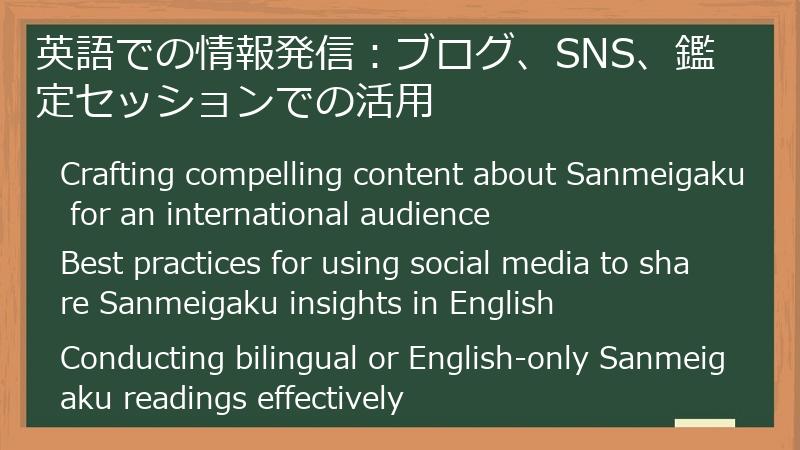
算命学の知識を深めることはもちろん、それを英語で発信し、世界中の人々との間で共有することは、その魅力を広める上で非常に重要です。このセクションでは、ブログ、SNS、そして鑑定セッションという、具体的な情報発信のチャネルごとに、算命学の内容を英語でどのように効果的に伝えられるかについて解説します。
「算命学 英語」というキーワードで検索する読者は、算命学を学びたい、あるいは海外の人に伝えたいと考えている層です。彼らが求めるのは、専門用語の解説、実践的なアドバイス、そして何よりも、算命学の奥深さと魅力を感じさせる情報です。ここでは、それぞれのチャネルに合わせた発信戦略と、注意すべき点について掘り下げていきます。
Crafting compelling content about Sanmeigaku for an international audience
国際的な読者向けの魅力的な算命学コンテンツ作成
算命学の魅力を英語で効果的に伝え、国際的な読者の興味を引くコンテンツを作成するためには、戦略的なアプローチが必要です。単に専門知識を羅列するだけでなく、彼らの文化的背景や関心事に寄り添い、算命学が持つ普遍的な価値を伝えることが重要です。ここでは、ブログ記事、ウェブサイトのコンテンツ、あるいは Eブックなど、様々な形式での情報発信において、魅力的なコンテンツを作成するための具体的な方法を解説します。
コンテンツ作成の核となるのは、算命学が提供する「自己理解」と「人生の可能性」というテーマを、国際的な読者にとってどのように関連付け、魅力的に提示できるかという点です。具体的には、以下の要素を考慮すると良いでしょう。
- Start with Universal Themes: Frame Sanmeigaku’s concepts around universal human aspirations such as finding purpose, understanding relationships, navigating challenges, and unlocking potential. For example, instead of just explaining “Five Elements,” discuss how their balance influences aspects like health, career, and relationships – topics relevant to everyone.
- Use Relatable Analogies and Examples: As discussed previously, analogies and concrete examples are crucial for bridging language and cultural gaps. Frame complex ideas using everyday situations or natural phenomena that international readers can easily grasp.
- Focus on “How-To” and Practical Applications: Readers are often looking for actionable insights. Content that explains how Sanmeigaku can be used for self-improvement, decision-making, or understanding others will be more engaging. For instance, “How to understand your elemental strengths for career success” or “Using Sanmeigaku to improve communication in relationships.”
- Visual Appeal: Incorporate well-designed graphics, charts, and diagrams to illustrate concepts. Visual aids can significantly enhance understanding, especially when dealing with abstract ideas. A well-formatted “Destiny Chart” example or a simple diagram of elemental cycles can be very effective.
- Clear and Accessible Language: While using necessary technical terms, ensure they are clearly explained. Avoid overly academic or jargon-heavy language. Use shorter sentences and paragraphs for better readability.
- Storytelling: Share anonymized case studies or personal anecdotes (with permission) that illustrate how Sanmeigaku has helped individuals. Stories resonate deeply and make the information more memorable.
- Address Common Questions: Anticipate what international readers might wonder about Sanmeigaku (e.g., how it differs from Western astrology, whether it’s deterministic). Proactively answer these in your content.
ブログ記事の構成例としては、以下のような流れが考えられます。
- Catchy Title: Something that sparks curiosity, e.g., “Unlock Your Life’s Blueprint: An Introduction to Sanmeigaku,” or “Discover Your Innate Talents with Chinese Destiny Analysis.”
- Engaging Introduction: Start with a relatable question or statement about life’s uncertainties or the desire for self-understanding.
- Core Concept Explanation: Introduce Sanmeigaku, its philosophical basis (Yin-Yang, Five Elements), and its purpose (self-understanding, not just prediction).
- Key Components: Briefly explain Heavenly Stems, Earthly Branches, and the Destiny Chart.
- Practical Benefit/Application: Discuss how Sanmeigaku can be used for personal growth, career, or relationships, using analogies and examples.
- Call to Action: Encourage readers to learn more, perhaps by downloading a free guide, signing up for a newsletter, or considering a reading.
SNSでの情報発信においては、視覚的な要素(画像、短い動画)を効果的に活用し、専門用語は避けつつ、興味を引くような短いキャプションで算命学の断片的な魅力(例:今日の運勢、各干支の特性など)を発信することが有効です。
| Content Element | English Explanation | Purpose |
|---|---|---|
| Universal Appeal | Focus on topics like self-discovery, relationships, career, and well-being. | Connect with readers from diverse backgrounds. |
| Clarity & Simplicity | Use straightforward language and avoid excessive jargon. Explain technical terms when necessary. | Ensure accessibility and comprehension for non-native English speakers or beginners. |
| Practicality | Offer actionable advice and insights that readers can apply to their lives. | Demonstrate the real-world value of Sanmeigaku. | Employ graphics, charts, and diagrams to illustrate complex ideas. | Enhance understanding and engagement. |
| Storytelling | Share compelling narratives or case studies. | Make concepts relatable and memorable. |
魅力的なコンテンツ作成の鍵は、算命学の知恵を、国際的な読者が理解し、共感し、そして自身の人生に役立てられる形で提供することにあります。これらの戦略を実践することで、算命学の魅力を効果的に英語で発信し、より多くの人々にその価値を届けることができるでしょう。
Best practices for using social media to share Sanmeigaku insights in English
算命学の洞察を英語で共有するためのSNS活用術
ソーシャルメディア(SNS)は、算命学の知識や洞察を世界中の人々に向けて発信する上で、非常に強力なツールとなります。特に英語での情報発信においては、ターゲット層にリーチし、エンゲージメントを高めるための戦略的な活用が求められます。このセクションでは、Facebook、Instagram、Twitter(X)などのプラットフォームで、算命学の魅力を効果的に伝えるためのベストプラクティスを解説します。
SNSでの情報発信の鍵は、簡潔さ、視覚的な魅力、そしてインタラクティブなコミュニケーションにあります。専門的すぎる内容や長文は避け、多くの人々が気軽にアクセスできるような形式で提供することが重要です。
以下に、SNSで算命学の洞察を英語で共有する際の具体的な戦略とポイントを挙げます。
- Platform-Specific Content:
- Instagram: Highly visual. Use appealing graphics featuring symbols, elements, or even aesthetically pleasing representations of the “Destiny Chart.” Short video snippets explaining a single concept (e.g., “What is the Metal element?”) or “Did you know?” facts work well. Use relevant hashtags like #Sanmeigaku, #ChineseAstrology, #BaZi, #DestinyAnalysis, #SelfDiscovery, #ElementalBalance.
- Facebook: Allows for slightly longer posts, more detailed explanations, and community building through groups. Share blog post excerpts, discuss common misconceptions, and pose questions to encourage comments.
- Twitter (X): Best for concise, impactful messages. Share daily or weekly “elemental insights,” quick tips for working with specific energies, or links to longer content. Use relevant hashtags and engage in conversations.
- LinkedIn: Suitable for a more professional audience. Focus on how Sanmeigaku can be applied to career development, leadership, or understanding team dynamics.
- Content Ideas for Social Media:
- “Element of the Day/Week”: Briefly explain the characteristics and influences of a specific element or stem/branch.
- “Sanmeigaku Tip”: Offer practical advice related to elemental balance or energy flow in daily life.
- “Myth vs. Fact”: Address common misunderstandings about Sanmeigaku or Chinese astrology.
- “Relationship Insights”: Discuss how elemental interactions influence relationships (using anonymized or generalized examples).
- Q&A Snippets: Answer frequently asked questions in a concise, engaging manner.
- Quote Graphics: Share insightful quotes related to fate, destiny, self-awareness, or the philosophical underpinnings of Sanmeigaku, paired with relevant imagery.
- Engagement Strategies:
- Ask Questions: Encourage followers to share their thoughts or experiences related to the post’s topic.
- Run Polls: Use platform features to ask followers about topics they’d like to learn more about.
- Respond to Comments: Actively engage with your audience, answering questions and fostering a sense of community.
- Go Live: Consider occasional live Q&A sessions or short talks on specific Sanmeigaku topics.
- Hashtag Strategy: Use a mix of broad hashtags (#ChineseAstrology, #Metaphysics) and specific ones (#Sanmeigaku, #BaZi, #FiveElements, #DestinyChart) to reach both general and niche audiences.
SNSでの発信は、一貫性が重要です。定期的に投稿することで、フォロワーのエンゲージメントを維持し、信頼関係を築くことができます。また、分析結果の共有に際しては、個人情報やプライバシーに配慮し、一般論や普遍的な傾向に焦点を当てるようにしましょう。
| Practice | Description | Benefit |
|---|---|---|
| Visual Content | Use high-quality images, graphics, and short videos. | Captures attention and enhances understanding of complex concepts. |
| Concise Messaging | Deliver key insights in short, digestible posts. | Increases engagement and accessibility on fast-paced platforms. |
| Clear Explanations | Define technical terms simply or avoid them in favor of analogies. | Makes the information accessible to a wider audience. |
| Engagement | Ask questions, respond to comments, run polls. | Builds community and fosters interaction. |
| Consistency | Post regularly to maintain audience interest. | Builds brand recognition and follower loyalty. |
| Hashtag Usage | Utilize relevant and targeted hashtags. | Increases visibility and reach. |
SNSを効果的に活用することで、算命学の知恵を英語で世界に発信し、多くの人々の自己理解と成長をサポートする活動に繋げることができます。発信する情報が、相手にとって有益で、かつ魅力的に感じられるような工夫を凝らすことが、成功の鍵となります。
Conducting bilingual or English-only Sanmeigaku readings effectively
バイリンガルまたは英語のみでの算命学鑑定の効果的な実施
算命学の知識を活かして、英語を母国語とするクライアントや、英語でのコミュニケーションを希望するクライアントに対して鑑定を行う場合、その効果的な実施方法が重要になります。言語の壁を越え、クライアントに深い洞察と満足感を提供するためには、事前の準備と、鑑定中のコミュニケーション戦略が鍵となります。このセクションでは、バイリンガルまたは英語のみでの算命学鑑定を効果的に行うための実践的なアドバイスを提供します。
鑑定の質は、専門知識の深さだけでなく、それをどのようにクライアントに伝えるか、というコミュニケーション能力にも大きく依存します。特に、翻訳や文化的なニュアンスの違いを考慮しながら進める必要がある場合、以下のような点が重要になります。
- Preparation is Key:
- Master Key Terminology: Ensure you have a solid grasp of English translations and explanations for all core Sanmeigaku concepts (Heavenly Stems, Earthly Branches, Five Elements, Day Master, Luck Pillars, etc.). Practice explaining them clearly and concisely.
- Develop Standard Phrases: Prepare common phrases and explanations in English that you can use consistently. This will help you communicate more smoothly and professionally.
- Cultural Sensitivity Checklist: Be aware of potential cultural differences in how concepts like “destiny,” “karma,” or “advice” are perceived.
- During the Reading:
- Start with a Clear Introduction: Begin by explaining what Sanmeigaku is in simple English, setting expectations, and clarifying the process. For example, “Sanmeigaku is an ancient Chinese system of destiny analysis that uses your birth date and time to create a unique energetic blueprint of your life. Today, we will explore this blueprint to understand your innate potential, challenges, and opportunities.”
- Use Simple and Clear Language: Avoid overly complex jargon. Opt for straightforward explanations and use analogies where appropriate. Check for understanding frequently. “Does that make sense?” or “Are you following me so far?” are useful phrases.
- Active Listening: Pay close attention to the client’s responses and questions. Ensure you understand their concerns before providing advice.
- Visual Aids: If possible, use a visual representation of the Destiny Chart. Pointing to different elements and explaining their significance in English can be very helpful.
- Pacing: Speak at a moderate pace, allowing the client time to process the information, especially if English is not their first language.
- Focus on Empowerment: Frame interpretations and advice constructively, emphasizing the client’s agency and potential for growth.
- Bilingual vs. English-Only Readings:
- Bilingual Readings: If you are fluent in both languages, you can use both to clarify meanings. However, ensure that the primary explanation remains in English for clarity if the client prefers it. Sometimes, using the Japanese term and then immediately providing its English explanation can be effective.
- English-Only Readings: If you are conducting a reading solely in English, it’s crucial to be highly proficient and prepared with your explanations. This is often preferred by clients seeking an entirely English-language experience.
- Providing Advice in English: Ensure advice is practical, actionable, and culturally sensitive. Frame it as suggestions rather than commands. For instance, instead of “You must do X,” say “One approach that could be beneficial for you, given the energies in your chart, is to consider exploring X.”
鑑定の前後で、クライアントにフィードバックを求めることも、自身のスキル向上に繋がります。どのような説明が分かりやすかったか、どのような点に疑問が残ったかなどを尋ねることで、次回以降の鑑定をより洗練させることができます。
| Strategy | Description | Key English Phrases / Actions |
|---|---|---|
| Setting Expectations | Clearly outline the process and scope of the reading in English. | “Today we’ll be looking at your Destiny Chart to understand your innate energies and potential.” |
| Simplifying Language | Use clear, direct English and avoid overly technical jargon. | “This element represents…” “This interaction suggests…” “Think of it like…” |
| Active Listening & Clarification | Ensure the client understands and has their questions answered. | “Does that make sense?” “Would you like me to explain that further?” “What are your thoughts on this?” |
| Constructive Advice | Offer guidance that empowers and suggests possibilities. | “Consider exploring…” “One approach could be…” “This might help to balance…” |
| Cultural Nuance Check | Be mindful of how concepts might be perceived differently across cultures. | Subtly adjust phrasing to be universally understood and respectful. |
効果的なバイリンガルまたは英語のみでの算命学鑑定は、専門知識だけでなく、高度なコミュニケーション能力と異文化理解を必要とします。これらの戦略を実践することで、言語の壁を乗り越え、クライアントに真に価値のある鑑定体験を提供することができるでしょう。
コメント